
Top Lab Equipment Supplier for Government and MOE Tenders to Nigeria, Kenya, Ethiopia, Tanzania, Ghana
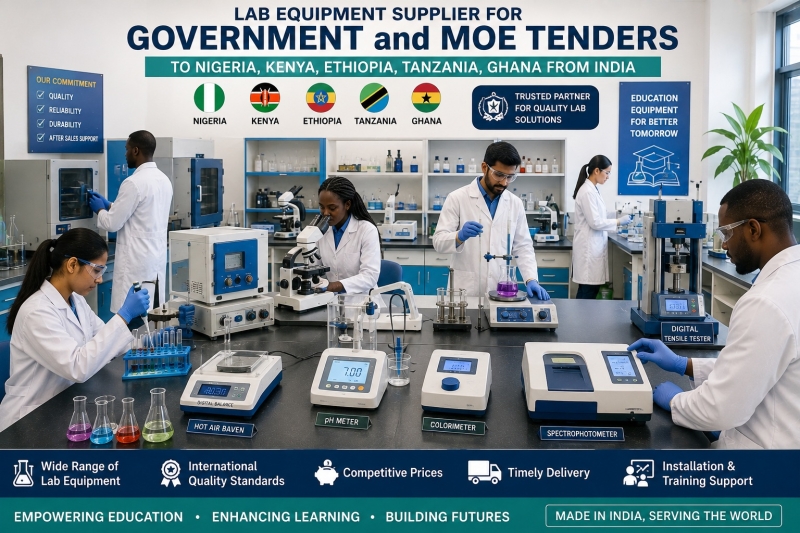
Every year, ministries of education across Africa, Asia and the Gulf publish thousands of tenders for school science labs, technical university workshops and TVET training centres. On paper, these tenders look straightforward: a bill of quantities, a deadline, a bid bond. In practice, most bids fail long before delivery — not because the price was too high, but because the supplier behind the bid could not meet the specification, the documentation or the timeline.
If you are a procurement officer writing a tender, or a bidder responding to one, choosing the right manufacturing partner is the single decision that determines whether the project succeeds. Here is what actually matters.
1. Specification compliance beats price
The most common reason a lab equipment bid gets disqualified is technical non-compliance. A tender might specify a compression testing machine with a particular capacity and a specific calibration standard. A trader sourcing from an open market can offer something close — but "close" is a rejection.
This is where working directly with a manufacturer changes the outcome. A manufacturer can build to the specification rather than search for something that approximately matches it. When your tender document calls for a triaxial testing system with defined cell pressure ranges, or a Marshall stability tester conforming to a named standard, a factory can engineer to that line item.
Ask any prospective supplier a simple question: can you map every line of my BOQ to a product code with a datasheet? If they hesitate, they are a reseller, not a manufacturer.
2. Documentation is half the tender
Government procurement runs on paper. A technically perfect machine with incomplete documentation will still fail evaluation.
At minimum, your supplier should provide technical datasheets for every line item, calibration certificates, compliance sheets mapped to the tender's stated standards, country-of-origin and warranty documentation, and export packing lists. For World Bank and donor-funded projects, requirements go further — expect eligibility documentation and procurement-standard formatting.
Suppliers who treat documentation as an afterthought create problems that surface at the worst possible moment: at the evaluation committee, or at customs.
3. Understand what "turnkey" really means
Many tenders are not equipment purchases at all. They are laboratory projects. The difference matters enormously.
A supply-only bid ends when the crates arrive. A turnkey bid covers design and layout, supply, installation, commissioning and staff training. If a tender for a TVET refrigeration workshop only delivers boxes, the institution ends up with equipment nobody can install and instructors who cannot teach with it.
Before you bid, confirm whether your supplier can physically support installation and training in-country, or coordinate with a local partner who can.
4. Check the category depth
Institutional tenders are rarely narrow. A single civil engineering tender might require soil testing, concrete and aggregates, bitumen, asphalt and non-destructive testing equipment — hundreds of individual line items across categories.
Sourcing each category from a different supplier multiplies your risk: five lead times, five sets of documentation, five points of failure. A manufacturer with genuine depth across civil, material and workshop testing lab equipment consolidates that into one bid, one shipment and one warranty.
Depth also signals experience. A supplier that stocks a Benkelman beam, a falling weight deflectometer and a rock shear box apparatus has clearly delivered highway and geotechnical projects before.
5. Verify export experience — not just export capability
There is a real difference between a factory that can export and one that regularly does. Export experience shows up in details: packing built for sea freight and humid climates, familiarity with destination-country customs requirements, realistic lead times, and responsiveness across time zones.
Ask which countries they have actually shipped to, and for which ministries. A supplier with genuine tender history across Nigeria, Kenya, Ethiopia, Tanzania, Ghana and the Gulf has already solved the problems your project will encounter.
Naugra Export India - Quotation with technical specifications within 24 to 48 hours.
Tender deadlines are unforgiving. If a supplier takes two weeks to return a quotation during the bidding phase — when they are trying to win your business — that is the fastest they will ever move.
Send a partial BOQ and time the response. A serious tender team returns a compliant, priced quotation with technical specifications within 24 to 48 hours.
Getting it right from the start
The suppliers who win MOE tenders consistently are rarely the cheapest. They are the ones who read the specification carefully, document thoroughly, deliver on schedule and support the institution after commissioning.
If you are preparing a bid or drafting a tender specification, start by understanding the full equipment scope you are dealing with. You can review the complete category range — from soil and rock testing through to concrete, asphalt, NDT and TVET workshop equipment — on our lab equipment supplier for Government & MOE tenders page, along with the countries we currently supply.
Naugra Export India - Send your tender document or BOQ, and our team will map each line item to a compliant product code with full documentation.
Specifying a laboratory or preparing a tender?
Send us your syllabus, scope or BOQ. We will build the item list with the grades, standards and calibration requirements stated against each line, so the quotation you receive is comparable.
Bulk supply and tender enquiries
Everything in this guide is manufactured in our own unit and supplied in bulk to schools, colleges, contractors and government tenders in over 90 countries. Browse the range, or send us a BOQ and we will quote against it line by line.