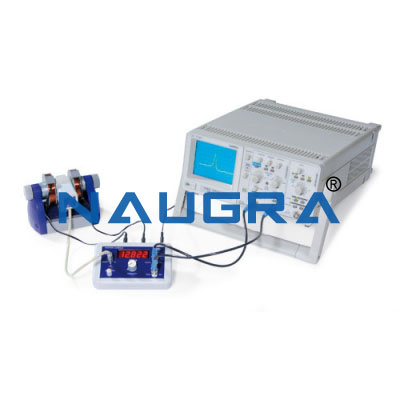
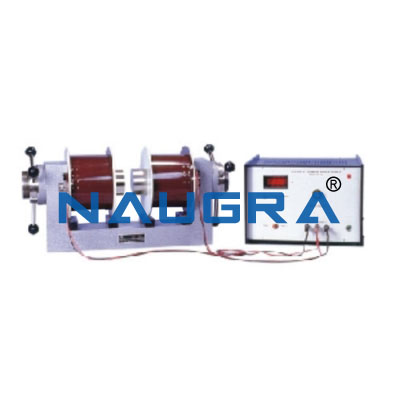
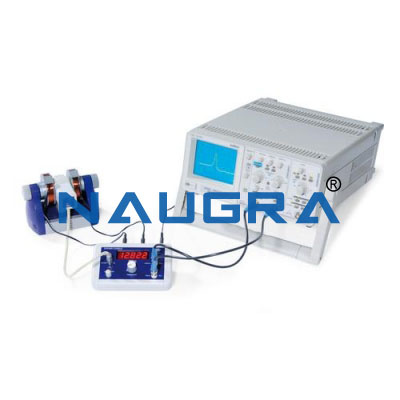
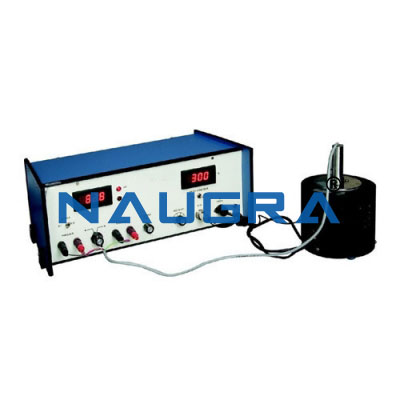
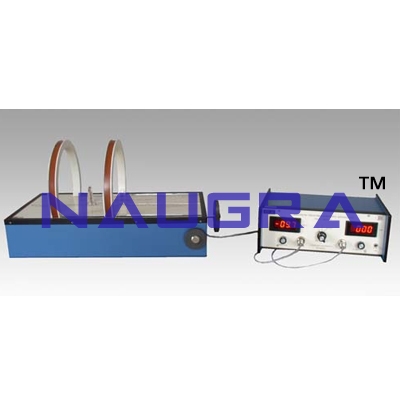
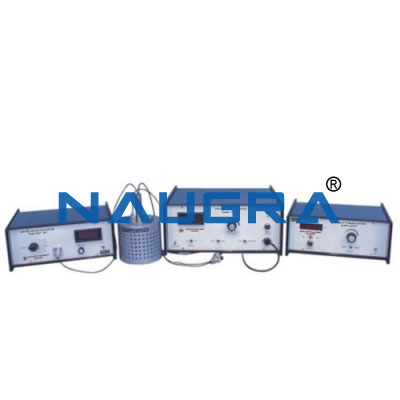
Electron Spin Resonance Spectrometer Experiments for High School Science Kits Lab — specification
We manufacture the Electron Spin Resonance Spectrometer Experiments for High School Science Kits Lab in Ambala Cantt for laboratory teaching and testing laboratories, and supply it worldwide against institutional and tender orders. See the full High School Science Kits range.
Electron Spin Resonance Spectrometer Experiments for Physics Lab -
Magnetic Resonance has developed into a very useful and powerful tool in
solid state research. In this method, use is made of the Zeeman
interaction of the magnetic dipoles associated with the nucleus or
electron, when placed in an external magnetic field. Accordingly, they
are identified as NMR (Nuclear Magnetic Resonance) or ESR (Electron Spin
Resonance). This form of spectroscopy finds many applications in the
investigation of crystal structures, environmental effects, dynamic
effects, defects in solids and in many diverse branches of Physics,
Chemistry and Biology.
Elementary Magnetic Resonance
We know that the intrinsic angular momentum (spin) of the electron S
couples with the orbital angular momentum of the electron to give a
resultant and this coupling gives rise to the ‘fine structure’ of the
spectra. Further, under the influence of an external magnetic field (H)
each of the level will split into (2j+1) sublevels (Zeeman effect) and
the splitting of a level will be
DE = (gµ0H)mj
where µ0 is the Bhor magneton, g is the Lande’ g-factor and mj is the
magnetic quantum number. As can be seen, the splitting is not same for
all levels; it depends on the and of the level (s=½ always for one
electron). However, the sublevels will split equally by an amount
DE = gµ0H 0r = hn0
where n0 is the frequency of the system. Now if the electron is
subjected to a perturbation by an oscillating magnetic field with its
direction perpendicular to the static magnetic field and its frequency
n1such that the quantum n1 is equal to E=hn0, we say that there is a
resonance between n1 and n0. This willinduce transition between
neighbouring sublevels (mj=±1) and in turn will absorb energy from
oscillating field. Thus, at resonance, we get a peak due to the
absorption of energy by the system
Experimental Technique
If we consider a free electron and substitute the proper value of
constants in the equation: g=2.00, µ0=0.927X10⁻²⁰ erg/gauss &
h=6.625 X l0-27 erg sec, we get = 2.8MHz/gauss
That is ESR can be observed at radio frequencies in a magnetic field of a
few gauss or in the microwave region in a magnetic field of a few
kilogauss. The latter alternate has many advantages: improved
signal-to-noise ratio, high resolution etc. and is always preferred for
accurate work, though it is very sophisticated and expensive. However,
if the basic understanding of the subject is the main criteria as is
usually the requirement of class room experiments, the observation of
ESR in low magnetic field and in a radio frequency region makes it a lot
simple, inexpensive and within the reach of every post-graduate
laboratory.
Description of the ESR Spectrometer
A block diagram of the ESR Spectrometer is given below in Fig. 1, and a
brief description follows.
Basic Circuit
The first stage of the ESR circuit consists of a critically adjusted
(marginal) radio frequency oscillator with 4-digit frequency display.
This type of oscillator is required here, so that the slightest increase
in its load decreases the amplitude of oscillation to an appreciable
extent. The sample is kept inside the tank coil of the oscillator, which
in turn, is placed in the 50Hz magnetic field, generated by the
Helmholtz coils. At resonance, i.e. when the frequency of oscillation
equal to the Larmour’s frequency of the sample, the oscillator amplitude
registeres a dip due to the absorption of power by the sample. This
obviously, occurs periodically four times in each complete cycle of the
supply voltage. The result is an amplitude modulated carrier which is
then detected using a FET demodulator and amplified by an op-amp
circuit.
Highly stabilised and almost ripple free power supply for the above
circuit is obtained using an integrated circuit regulator.
Phase Shifter
This can compensate the undermined phase difference which may be
introduced in the amplification stages of the spectrometer and
oscilloscope.
50Hz Sweep Unit
A 50Hz current flows through Helmholtz coils which provides a low
frequency magnetic field to the sample. As the resonance is observed at
few gauss only, no static magnetic field is applied.
Oscilloscope (not supplied with the Spectrometer)
Any inexpensive oscilloscope normally available in the laboratory would
be quite suitable.
Advantages and Limitations of our Spectrometer
The instrument is basically designed for postgraduate laboratories
keeping in view their requirements and limitations.
The observation of ESR at low magnetic fields and consequently in
radio-frequency region makes its instrumentation and working a lot
simple and within the reach of a postgraduate students. Good resonance
peaks can be obtained as a class room exercise.
The spectrometer is complete in all respects including a sample DPPH
(except a CRO).
Features
FET based marginal R.F. Oscillator
Digital diaplay of frequency
Excellent peaks display
Digital display of Helmoltz Coil Current
Compatible with general pupose CRO in X-Y mode
For similar products visit at main page of High School Science Kits.
Bulk Tender Specialists
Bulk Order of Electron Spin Resonance Spectrometer Experiments for High School Science Kits Lab?
Send us your tender BOQ — we'll respond with a fully compliant manufacturer quote within 24 hours. Trusted by institutional & government buyers worldwide.
Get Tender Quote