
Chemistry Lab Apparatus: A Practical Guide to What Each Tool Does
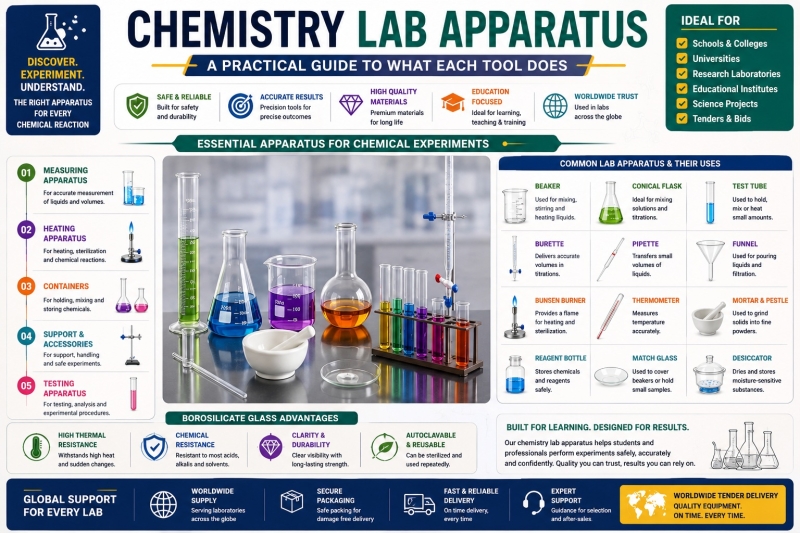
Walk into any school or college chemistry lab, and you'll find the same handful of tools showing up again and again, from the humble test tube to the fume hood standing quietly in the corner. Students often learn to use these pieces one experiment at a time, but they rarely get a full picture of why each one is shaped the way it is or what happens when someone swaps the wrong tool into the wrong job. A student who reaches for a beaker when the experiment calls for a volumetric flask isn't going to get an accurate result, no matter how careful their technique is.
This guide covers the chemistry lab equipment you'll find on almost any bench, grouped by what it actually does rather than by alphabetical order. It's meant to build a working sense of when to reach for each item and why the design choices behind it exist in the first place.
Measuring and Transferring Liquids
Glassware built for measurement is where most first-year mistakes happen, mainly because a lot of it looks interchangeable to a beginner.
Beakers
Beakers are the workhorses of the lab, but they're not precision tools. Their wide mouths make stirring and pouring easy, and the volume markings printed on the side work as rough guides, not exact readings. Use a beaker to hold, heat, or mix a liquid, and switch to something else the moment accuracy matters.
Graduated Cylinder
A graduated cylinder is designed for more precise volume measurement than a beaker. Its tall, narrow shape and graduated scale make it useful for measuring liquids when greater precision is needed, such as when preparing solutions or diluting samples. Reading the cylinder at eye level, at the bottom of the meniscus, builds a habit that matters more than it looks, since that single reading habit accounts for many of the small measurement errors students make early on.
Pipettes
Moving a small, exact volume of liquid from one container to another is a job for pipettes, whether the graduated glass kind or a modern micropipette. Titrations, serial dilutions, and any protocol involving microliter quantities depend on pipettes doing this reliably. A contaminated, damaged, or poorly calibrated pipette can throw off results in ways that are easy to miss until the data stops making sense.
Burette
A burette handles a related but different job: dispensing liquid drop by drop while a reaction changes in real time. The long, graduated tube with a stopcock at the bottom is built for titrations specifically, where the exact volume of reagent added at the moment of color change tells you the concentration of the unknown solution.
Volumetric Flask
When the job calls for a solution of a known, fixed concentration, a volumetric flask is the right tool. Each flask is calibrated to contain a specified volume at a specified reference temperature, marked by a single line on a long, narrow neck. That narrow neck isn't decorative; it reduces the surface area at the fill line so the reading stays sharp even with a slightly unsteady hand.
Containing and Reacting
Test Tubes
Running a small-scale reaction or heating a sample without committing a full beaker's worth of material is where test tubes earn their keep. Their open shape lets gas escape freely, which matters for reactions that produce fumes, and their small volume means you can run several variations of an experiment side by side without wasting reagents.
Conical (Erlenmeyer) Flasks
Conical flasks solve a problem beakers can't: swirling a liquid without splashing it out. The narrow neck and sloped sides make them ideal for titrations and for reactions where you need to mix by hand while keeping the contents contained.
Watch Glasses
Small jobs pile up in any lab, and watch glasses cover a surprising number of them. They work as makeshift lids for beakers to slow evaporation, as a surface for observing a small reaction up close, and as a place to weigh out solid reagents before adding them to a larger vessel. Their shallow, curved shape keeps loose powders from rolling off the edge.
Separating and Purifying
A funnel looks almost too simple to mention, but it prevents a surprising number of spills and wasted reagent. Paired with filter paper, a funnel becomes a basic filtration setup, separating solid particles from a liquid as it passes through. Buchner funnels take this further with a vacuum assist, speeding up filtration when time or volume makes gravity filtration impractical.
A centrifuge separates substances by spinning them at high speed, pushing denser material to the bottom of the tube while lighter material stays near the top. This comes up constantly in labs working with suspensions, where filtering alone would take far too long or wouldn't separate fine particles cleanly.
Splitting two liquids that don't mix, like oil and water, calls for a separating funnel. The pear shape and stopcock at the base let you drain the denser layer off cleanly while holding the lighter layer back, which is the backbone of liquid-liquid extraction.
Heating and Temperature Control
Cheap, portable, and genuinely controllable through its airflow collar, the Bunsen burner remains a common heat source in many teaching laboratories. It handles everything from sterilizing a wire loop to heating a solution to boiling.
Beginners tend to underrate the thermometer, since so many reactions are temperature-dependent in ways that aren't obvious from the color change or bubbling you can see. A thermometer confirms what's actually happening thermally, not just what appears to be happening, and that distinction often explains why two students running the same experiment get different results.
Background equipment like the retort stand and clamp rarely gets much thought, but it holds glassware steady over a heat source or during a multi-step setup like distillation. A wobbly clamp is a common cause of spilled reagents and broken glass, so its stability matters more than its plain appearance suggests.
Safety Equipment
No chemistry lab is complete without a layer of protective gear, and this equipment deserves the same seriousness as the glassware itself. Safety goggles guard against splashes and airborne particles, and they matter even during experiments that seem low-risk, since the biggest hazards often come from unexpected reactions rather than the ones you planned for. A lab apron or coat adds a barrier against spills reaching skin and clothing, while a fume hood serves as an important engineering control when work involves hazardous vapors, gases, fumes, or other airborne contaminants.
Choosing the Right Equipment for Your Lab
None of this equipment does much good sitting unused in a supply closet, and quality varies more than people expect. Glassware that's slightly off in its calibration will quietly skew every measurement taken with it, and safety gear that fits poorly tends to get skipped rather than worn. Schools and colleges setting up or restocking a chemistry lab are better off treating apparatus selection as part of the curriculum planning itself, not an afterthought once the syllabus is set.
Naugra Export supplies a full range of chemistry lab equipment for classroom and research use, from basic glassware to safety gear and heating apparatus, so labs can get fully equipped without piecing together items from a dozen different sources.
Frequently Asked Questions
What's the difference between a beaker and a flask?
A beaker has straight sides and a wide mouth, good for stirring and pouring but not precise measurement. A flask has a narrower neck that limits evaporation, and a volumetric flask holds one exact calibrated volume. Most benches need both.
Why is so much lab glassware made from borosilicate, and can plastic replace it?
Borosilicate glass resists thermal shock, so it can go from cold to hot without cracking, and it holds up better against acids and solvents. Plastic works fine for storage and wash bottles that never see direct heat, but anything heated over a flame still belongs in glass.
How often should lab thermometers and glassware be checked for accuracy?
The checking interval depends on the instrument, frequency of use, required accuracy, and the laboratory's quality-control procedures. Equipment used for quantitative work should be checked or calibrated according to an established schedule.
What should a school look for when buying new lab apparatus?
Calibration accuracy, durable safety gear, and a supplier who can restock reliably as the lab grows. Cheap equipment that's slightly off or breaks quickly usually costs more in the long run than it saves upfront.
How should glassware be cleaned and stored to avoid damage?
Rinse it promptly before residue dries on, and skip the hot oven for volumetric flasks and pipettes since heat cycling can shift their calibration. Store items upright and avoid stacking, since chipped rims are the most common damage in a busy lab.
What's a reasonable starter equipment list for a new chemistry lab?
Beakers, conical flasks, graduated cylinders, test tubes with a stand, a Bunsen burner, a thermometer, funnels with filter paper, and safety gear for every student cover the basics. Burettes, pipettes, and volumetric flasks come next once the syllabus moves into quantitative work.
Specifying a laboratory or preparing a tender?
Send us your syllabus, scope or BOQ. We will build the item list with the grades, standards and calibration requirements stated against each line, so the quotation you receive is comparable.
Bulk supply and tender enquiries
Everything in this guide is manufactured in our own unit and supplied in bulk to schools, colleges, contractors and government tenders in over 90 countries. Browse the range, or send us a BOQ and we will quote against it line by line.