
Anatomical Models Buying Guide for Schools, Colleges and Medical Training
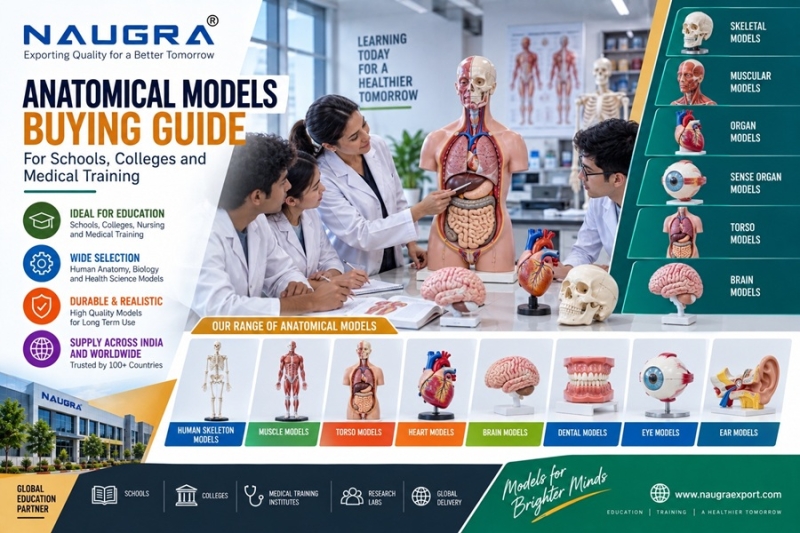
Anatomical models let students see and handle structures that are hard to understand from a textbook, from the chambers of the heart to the bones of the inner ear. They are used everywhere from secondary biology classrooms to nursing schools and medical colleges. Quality varies widely, though. This guide explains the main types of model, what to look for, and how to match models to your learners.
Main types of anatomical models
| Type | Examples | Typical users |
|---|---|---|
| Skeletons | Articulated full skeletons, disarticulated sets, skulls, spine and joint models | Schools, physiotherapy, nursing and medical colleges |
| Torsos | Sexless or dual-sex torsos with removable organs | Secondary and higher education |
| Organ models | Heart, brain, eye, ear, lungs, kidney, liver, skin, teeth | All levels |
| Muscle figures | Full or half-size muscular figures, limb models | Sports science, physiotherapy, medical colleges |
| Systems models | Digestive, circulatory, nervous, respiratory and reproductive systems | Secondary biology and nursing |
| Development models | Embryology and pregnancy series | Biology, nursing and midwifery |
| Cell and microscopic models | Animal and plant cells, DNA, neurons | Schools and introductory courses |
| Pathology models | Diseased organs for comparison with healthy tissue | Medical and nursing education |
Models versus simulators
Anatomical models show structure. Training manikins and simulators let learners practise skills such as CPR, injections, catheterisation or wound care. Medical and nursing programmes usually need both. See Naugra's hospital and medical lab range.
What to look for
Anatomical accuracy
Structures should be in the correct position and proportion, with realistic detail. Ask whether the model was developed with anatomical references or medical input.
Scale
Models may be life-size, reduced, or enlarged (common for the ear, eye, cells and teeth). The scale should be clearly stated.
Number of parts
Descriptions such as "torso, 23 parts" tell you how far the model can be taken apart. More parts means more teaching detail, but also more pieces to lose and more time to reassemble.
Labelling and key
Good models have numbered structures with a matching key or guide. Check that the key uses the terminology taught in your course.
Materials and finish
- Durable, non-toxic plastic that withstands regular handling
- Hand-painted or clearly coloured structures
- Secure fittings and magnets or pins for removable parts
- A stable base or stand
Ask the supplier to name the material and confirm it is suitable for classroom use.
Flexibility (skeletons and joints)
For physiotherapy and sports science, check that joints move realistically, and whether the spine is flexible.
Match models to your learners
- Primary and lower secondary: simple torsos, basic organ models (heart, eye, ear, teeth), a small skeleton, and charts.
- Upper secondary (IGCSE, A Level, IB, AP and national curricula): detailed torso, heart, brain, kidney, eye and ear models, plus a full-size skeleton and cell models.
- Nursing and allied health: full skeletons, detailed torsos, systems models, pregnancy series, and skills manikins.
- Medical colleges: high-detail organ and muscle models, disarticulated skeletons, pathology models and advanced simulators.
Plan a starter set
| Priority | Secondary school | Nursing / medical training |
|---|---|---|
| First | Human torso, heart, skeleton | Full skeleton, detailed torso, heart |
| Second | Eye, ear, brain, kidney | Brain, systems models, muscle figure |
| Third | Cell models, teeth, skin | Pregnancy series, pathology models, skills manikins |
Care and storage
- Store models covered, away from direct sunlight and heat, to prevent fading and warping.
- Clean with a soft cloth and mild soap solution. Avoid solvents.
- Count removable parts after each lesson.
- Carry skeletons by the stand, not the skull or limbs.
- Keep the key or guide with the model.
Buying checklist
- Model type, scale and number of parts stated.
- Material named and suitable for classroom use.
- Numbered key or guide included.
- Stable base or stand.
- Protective packing for shipping.
- Warranty and replacement parts available.
- Terminology matches your curriculum.
Anatomical models from Naugra Export
Naugra Export supplies anatomical models and charts for schools, colleges and medical training institutions, as part of complete biology lab or medical training lab orders. Browse teaching equipment or send your list to the tender desk.
Frequently asked questions
Which anatomical model should a school buy first?
A human torso with removable organs, as it covers several body systems in one model.
Are enlarged models accurate?
Yes, if made well. Enlargement makes small structures like the inner ear visible. The scale should be stated.
Do anatomical models replace dissection?
They complement it, and are a practical alternative where dissection is not permitted or practical.
Specifying a laboratory or preparing a tender?
Send us your syllabus, scope or BOQ. We will build the item list with the grades, standards and calibration requirements stated against each line, so the quotation you receive is comparable.
Bulk supply and tender enquiries
Everything in this guide is manufactured in our own unit and supplied in bulk to schools, colleges, contractors and government tenders in over 90 countries. Browse the range, or send us a BOQ and we will quote against it line by line.