
Chemistry Lab Apparatus and Equipment List for Tender Supply from India
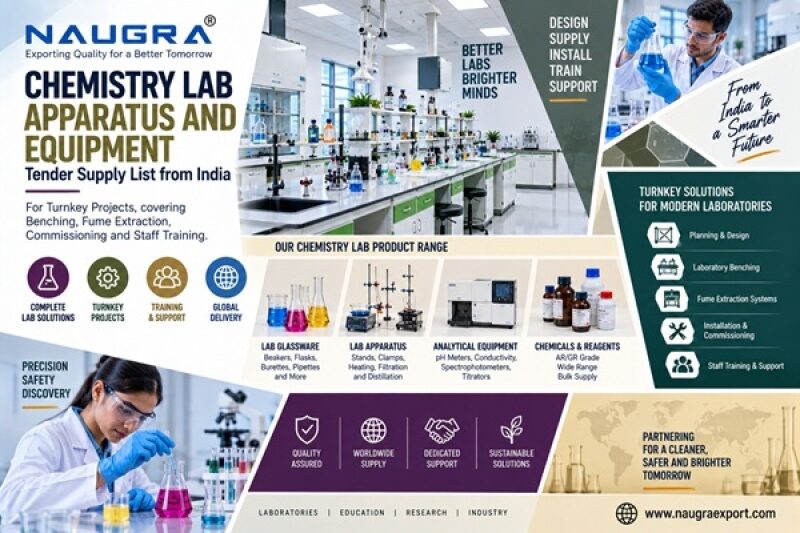
A chemistry tender is easier to write than a physics one and harder to price. The apparatus list is largely standard, so any supplier can quote it, but the differences hide inside the specification: whether the glass is borosilicate 3.3 or soda-lime, whether the volumetric ware is Class A or Class B, whether a balance reads to two decimals or four. Those choices move the bid total by a wide margin and decide whether the laboratory still works in five years. This list is organised the way a bill of quantities is usually structured, with the specification points that matter set out alongside.
Glassware: the largest section and the easiest to get wrong
Every chemistry laboratory starts with beakers, conical flasks, round-bottom and flat-bottom flasks, volumetric flasks, measuring cylinders, test tubes and boiling tubes, funnels, separating funnels, condensers, desiccators, reagent bottles and watch glasses. Two specifications carry most of the cost. The first is the glass: borosilicate 3.3 has the low expansion needed for anything heated or heated and cooled repeatedly, while soda-lime is acceptable for storage and for cold work. Specifying soda-lime for beakers to save money produces breakage in the first term. The second is the class of volumetric ware. Class A is manufactured and certified to tighter tolerance and is what a university quantitative analysis course needs; Class B is half the tolerance requirement and entirely sufficient for school titrations. Our laboratory glassware range carries both, and a schedule that states material and class per line will get comparable bids from every bidder.
Heating, measuring and separation apparatus
After glassware come the working instruments. Heating covers bunsen burners with the correct gas fittings for your supply, spirit lamps where gas is not piped, hot plates, magnetic stirrer hot plates, heating mantles for round-bottom flasks, water baths and drying ovens. Measuring covers balances — a top-pan balance reading to 0.01 g for general school use, an analytical balance to 0.0001 g for quantitative work — plus pH meters, conductivity meters, thermometers and hydrometers. Separation and analysis add centrifuges, filtration assemblies, distillation sets, Soxhlet extraction units, melting point apparatus and, at college level, colorimeters and spectrophotometers. The specification points that repay attention are the balance readability, the temperature range and stability of ovens and baths, and whether stirrer hot plates are chemical-resistant on the top plate. Our chemistry lab equipment range covers school through college requirements across all of these.
Chemicals, storage and the safety line
Reagents are quoted by grade, and the grade must be stated. Laboratory reagent grade suits most school practicals; analytical reagent grade is needed for quantitative analysis; technical grade belongs in a workshop, not a titration. A bidder quoting technical grade against an unstated requirement will always appear cheapest, which is why the schedule should name the grade and the pack size together. Storage is part of the same line of thinking: a chemical store needs separated cabinets for flammables, oxidisers and corrosives, ventilated where volatile material is held, with spill trays beneath. Safety equipment belongs in every chemistry tender — goggles, coats, gloves, fume extraction, eyewash, fire blanket and the right class of extinguisher. We cover the school-scale versions in our laboratory safety range, and the wider checklist is set out in our consumables and safety guide.
Furniture and services, which decide how the room works
Apparatus arrives into a room, and the room is frequently the weak point. A chemistry laboratory needs benching with a chemical-resistant top, sinks with adequate drainage, gas and electrical points positioned for the layout rather than for the wall, a demonstration bench with services, a fume cupboard where the syllabus requires it, and storage that separates apparatus from reagents. Where a tender is for a new build or a refurbishment, it is worth specifying the services layout at the same time as the apparatus, because retrofitting a gas point after benching is installed costs more than doing it once. We supply laboratory furniture and handle full room fit-outs under turnkey projects, including design, supply, installation, commissioning and teacher training.
Supplying from India: documentation, packing and lead times
For an overseas buyer the practical questions are what the documents look like and how long it takes. Our quotations are issued line by line against the tender schedule, with a product code, specification and unit price per line so an evaluation committee can score them without rewriting the bid. Shipments carry a commercial invoice, a packing list written to line item, a certificate of origin, and whatever conformity certificate the destination requires — SONCAP for Nigeria, PVoC under the KEBS or TBS schemes for Kenya and Tanzania, SASO and SABER for Saudi Arabia, CE where the buyer is in Europe. Glassware is packed in compartment cartons inside wooden crates, instruments individually boxed, furniture flat-packed where it travels better that way. Manufacturing runs four to six weeks for a standard school chemistry set and longer where analytical instruments are included, with sea transit on top. The certifications page sets out which scheme applies to which market.
Frequently asked questions
Do you quote against our tender document or your catalogue?
Against your document, line by line, with equivalents marked where we propose them rather than substituted silently.
What is the difference between Class A and Class B volumetric glassware?
Tolerance. Class A is manufactured and certified to a tighter limit and suits quantitative analysis; Class B is adequate for school-level titration and costs considerably less.
Can you supply chemicals with the apparatus?
Subject to what may legally be shipped to your port, which we check and confirm before quoting rather than at the time of shipment.
Is borosilicate necessary throughout?
No. Specify borosilicate 3.3 for anything heated and soda-lime where items are used for storage or cold work; mixing the two sensibly is how a budget is best spent.
Do you supply installation and training?
Yes for turnkey projects, covering benching, fume extraction, commissioning and staff training.
What warranty do you give?
Twelve months on manufactured apparatus and instruments against defects, with glassware and consumables excluded by nature.
The full range is listed under chemistry lab equipment, and our practical guide to chemistry apparatus explains what each item is used for. For tender pricing, send your BOQ to our tender team.
Specifying a laboratory or preparing a tender?
Send us your syllabus, scope or BOQ. We will build the item list with the grades, standards and calibration requirements stated against each line, so the quotation you receive is comparable.
Bulk supply and tender enquiries
Everything in this guide is manufactured in our own unit and supplied in bulk to schools, colleges, contractors and government tenders in over 90 countries. Browse the range, or send us a BOQ and we will quote against it line by line.