
Lab Consumables and Safety Equipment Checklist for Tenders in Philippines
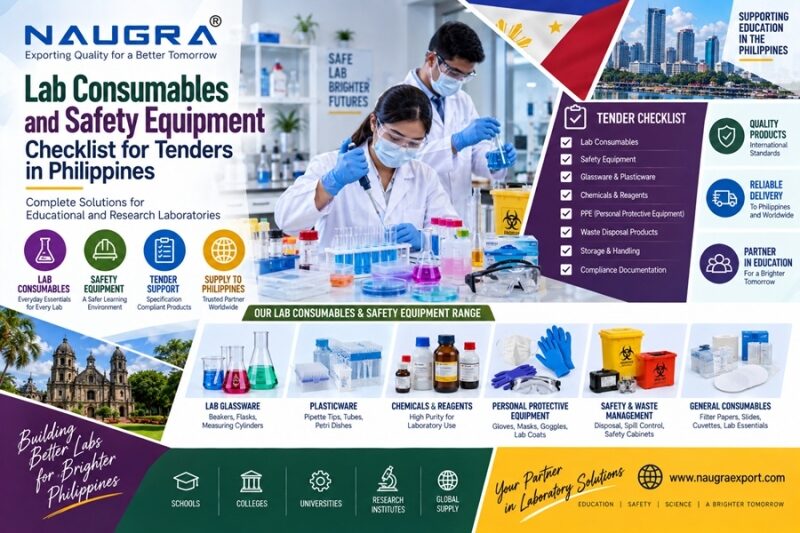
Consumables and safety equipment are the lines most often cut when a tender budget tightens, and they are the lines that decide whether a laboratory can open. A school with microscopes but no lens tissue, or a chemistry room with reagents and no eyewash, is not a working laboratory. For Philippine institutions procuring under the Government Procurement Reform Act, these items also carry a practical difficulty: they are bought in packs, sets and units that vary between suppliers, which makes bids hard to compare unless the schedule is written carefully. This checklist is organised for that problem.
How the requirement usually arrives
Most Philippine laboratory procurement runs through the electronic procurement system, with the requirement written by a school division office, a state university, a TESDA-accredited training centre or a hospital laboratory. Whoever writes it, the consumables section tends to be inherited from an older document and rarely matches the equipment actually being bought. The first thing worth doing is reading the consumables list against the equipment list: if the schedule buys thirty compound microscopes, it should also buy immersion oil, lens tissue and spare bulbs, and if it buys burettes it should buy burette brushes and stands. Where a supplier is asked to quote on a schedule that omits these, the honest response is to quote the schedule and flag the omission in the covering letter, which is what we do rather than quietly inflating the bid.
Glassware and plasticware consumables
This is the bulk of the list by line count. Beakers, conical and volumetric flasks, measuring cylinders, test tubes, boiling tubes, funnels, watch glasses, petri dishes, pipettes, burettes and reagent bottles all appear, and the specification that matters is the material and the class. Borosilicate 3.3 for anything heated, soda-lime for storage where cost dominates, and Class A or Class B for volumetric ware depending on whether the work is quantitative. Class A costs more and is worth it for a university titration class; Class B is sensible for a junior high school. Plasticware — wash bottles, beakers, funnels, measuring cylinders, reagent bottles, test tube racks — takes the handling that breaks glass, and polypropylene survives autoclaving where polyethylene does not. Our laboratory glassware range lists both classes and both materials so a schedule can be matched exactly. Add brushes, corks, rubber bungs, tubing, filter paper, litmus and pH papers, spatulas, droppers and slides; these are pennies individually and the reason a practical is cancelled when missing.
Safety equipment: the non-negotiable section
Safety divides into personal protection, room fittings and emergency response. Personal protection means safety spectacles and goggles sized for students, laboratory coats, heat-resistant and chemical-resistant gloves, and face shields where the syllabus includes anything vigorous. Room fittings mean a fume hood or extraction where volatile reagents are used, a chemical storage cabinet with separation for oxidisers and flammables, spill trays and a spill kit with absorbent and neutraliser. Emergency response means an eyewash station within a few seconds' walk of every bench, a safety shower where the scale of work justifies it, a first aid kit, a fire blanket and fire extinguishers of the correct class — carbon dioxide or dry powder near electrical equipment, never water. Our school laboratory safety range covers the school-scale versions of all of these. Two details are worth writing into the schedule: extinguishers need servicing, so specify who does it, and eyewash bottles have expiry dates, so specify replacement intervals.
Writing the schedule so bids can be compared
The single most useful thing a Philippine procuring entity can do is fix the unit of issue. "Filter paper — 100 sheets" is comparable; "filter paper — 1 pack" is not, because one bidder means 100 sheets and another means 500. The same applies to test tubes by the dozen or the gross, gloves by the box of 50 or 100, and reagents by weight or volume rather than by bottle. Where a chemical is specified, state the grade — laboratory reagent, analytical reagent or technical — because the price difference is several-fold and a bidder quoting technical grade against an analytical requirement will always look cheaper. Finally, set a delivery split: consumables have shelf lives, and a three-year supply delivered on day one is a three-year supply that expires in storage.
Import, delivery and what we supply
Shipments to the Philippines arrive through Manila, Cebu or Davao depending on the consignee, and laboratory glassware, plasticware and safety equipment are straightforward to clear with an invoice, packing list and certificate of origin. Chemicals are the exception and need checking case by case before shipment, since some require permits and some cannot be carried by sea freight at all; we raise this at quotation stage rather than at the port. Everything is packed to line item so a receiving committee can inspect against the schedule during acceptance, which matters when acceptance triggers payment. Lead times run four to six weeks for manufactured items, less for stock consumables, plus around three weeks of transit.
Frequently asked questions
Do you supply chemicals as well as apparatus? We supply laboratory chemicals subject to a check on what may be shipped to your port, and we say plainly at quotation stage which items we cannot send. Can you quote against our exact schedule? Yes. Send the document and we quote line by line, marking equivalents where we propose them. What documentation comes with the shipment? Commercial invoice, packing list to line item, certificate of origin, and material or conformity documentation where the item requires it. Is there a minimum order? No fixed minimum, though consolidating consumables with equipment into one shipment is usually cheaper per line. How do you handle breakage in transit? Glassware is packed in compartment cartons inside crates; where a shortage or breakage is recorded on the acceptance report, we replace it on the next consignment. Do you supply to TESDA and DepEd specifications? We quote against whatever specification the schedule carries, including where it names a national standard.
For the wider picture, our tender checklist covers procurement structure, and the glassware guide explains types and uses in detail. Send your schedule to our tender team for a line-by-line quotation.
Specifying a laboratory or preparing a tender?
Send us your syllabus, scope or BOQ. We will build the item list with the grades, standards and calibration requirements stated against each line, so the quotation you receive is comparable.
Bulk supply and tender enquiries
Everything in this guide is manufactured in our own unit and supplied in bulk to schools, colleges, contractors and government tenders in over 80 countries. Browse the range, or send us a BOQ and we will quote against it line by line.