
Laboratory Glassware List Types Names Uses
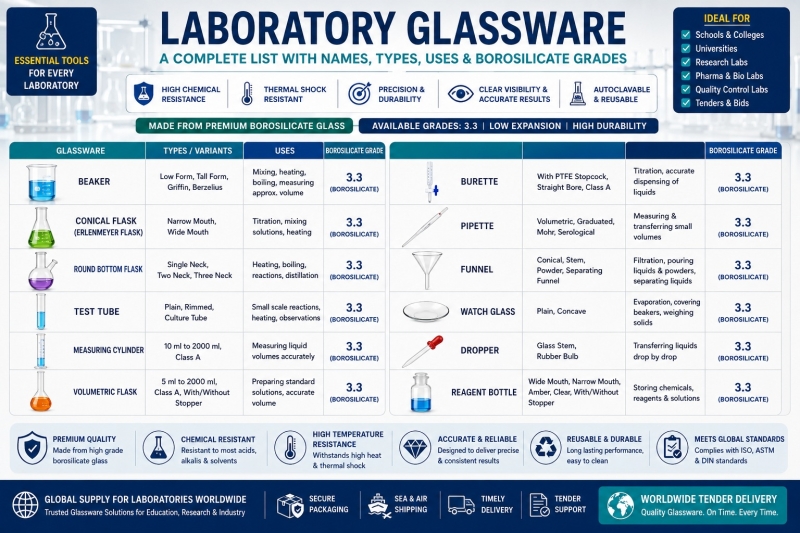
Laboratory Glassware List: Every Type, Name and Use - Start here: borosilicate 3.3 or soda-lime?
This one decision matters more than every other choice on the page.
Borosilicate 3.3 has a coefficient of thermal expansion of about 3.3 × 10⁻⁶/K. It expands so little on heating that the stress between hot and cold regions stays below the point where the glass fails. That is why it survives a Bunsen burner, a hot plate and a sudden cold rinse.
Soda-lime glass has a coefficient around 9 × 10⁻⁶/K — roughly three times as much. It is cheaper, perfectly good, and will crack on its third heating cycle.
| Borosilicate 3.3 | Soda-lime | |
|---|---|---|
| Standard | ISO 3585, ASTM E438 Type 1 Class A | ISO 4012, ASTM E438 Type 2 |
| Thermal expansion | ~3.3 × 10⁻⁶/K | ~9 × 10⁻⁶/K |
| Max working temp | ~500 °C | ~110 °C |
| Chemical resistance | High to acids and neutral solutions | Moderate |
| Use it for | Anything heated: beakers, flasks, tubes, condensers | Storage bottles, specimen jars, unheated ware |
| Roughly | 40–60% more expensive | Cheaper |
The practical rule: if it goes on a tripod, a hot plate, a mantle or into an autoclave, specify borosilicate 3.3. If it holds a reagent on a shelf, soda-lime is honest value.
A supplier who will not state the grade in writing has told you which one it is.
Measuring glassware: how accurate is accurate?
The second thing people get wrong is using the wrong vessel for the number they need.
| Vessel | Typical accuracy | Use it for |
|---|---|---|
| Beaker | ±5% | Never for a measured volume |
| Conical flask | ±5% | Never for a measured volume |
| Measuring cylinder | ±0.5 to 1% | Approximate volumes, dilutions |
| Graduated (Mohr) pipette | ±0.5% | Variable volumes, moderate accuracy |
| Burette, 50 ml Class A | ±0.05 ml | Titration |
| Volumetric pipette, 25 ml Class A | ±0.03 ml | Aliquots |
| Volumetric flask, 250 ml Class A | ±0.15 ml | Standard solutions |
Class A and Class B
Class A ware is individually calibrated, carries a serial number, and should be supplied with a works certificate stating its actual volume. Class B is calibrated by batch at roughly double the tolerance and costs considerably less.
Buy Class A for anything whose result goes into a report, a quality record or an examination mark. Class B is fine for teaching where students are learning the technique rather than producing a certified number.
“In” and “Ex”
Look for TC / In or TD / Ex etched on the item. In means the vessel contains the stated volume — volumetric flasks. Ex means it delivers the stated volume, allowing for the film that stays behind on the wall — pipettes and burettes. Blowing out the last drop of an Ex pipette overdelivers, which is why a bulb pipette has a small residual volume by design.
What determines which glassware you measure with
Three questions, in order:
- How accurate does the answer need to be? That sets the vessel type from the table above.
- Does it need to be heated? If yes, borosilicate 3.3, and never a volumetric flask.
- What is the chemistry? Alkali attacks glass slowly and will seize a glass stopcock permanently; hydrofluoric acid attacks it fast and needs plastic instead.
The laboratory glassware list
Containers and reaction vessels
Beaker — cylindrical, flat-bottomed, spouted. Holding, mixing, heating. Low form is standard; tall form gives more depth for stirring. Graduations are indicative only. 25 ml to 5,000 ml; a school lab needs 100, 250 and 500 ml in quantity.
Conical flask (Erlenmeyer) — cone body, narrow neck. Swirl hard without spilling. The titration vessel. Narrow-neck versions take a stopper or cotton plug for culture work.
Volumetric flask — pear body, long neck, one etched ring. Preparing solutions to an exact volume. Never heat it: the calibration is set at 20 °C and heating destroys it permanently.
Round bottom flask — spherical, for distillation, reflux and vacuum. Needs a cork ring or clamp. One, two and three-neck versions.
Flat bottom flask — stands up, boils fine, not for vacuum.
Buchner flask (filter flask) — thick-walled with a side arm for a vacuum line. Thick walls are the point; a thin flask implodes.
Culture flask, Roux bottle and Kjeldahl flask — specialist shapes for microbiology, culture and nitrogen digestion.
Tubes
Test tube — thin-walled, quoted as diameter × length. 12×75, 16×150 and 25×150 mm are the common sizes. Rimmed pours more cleanly; unrimmed takes a stopper more neatly.
Boiling tube — larger and thicker-walled, made to take direct flame. If your test tubes are cracking over a burner, this is the item you actually needed.
Graduated reaction tube — a graduated, often conical-based tube for small-scale reactions where the volume needs reading. Common in semi-micro qualitative analysis.
Centrifuge tube — conical base, graduated, made to survive spinning.
Capillary tube — very fine bore, one end sealed, for melting point determination.
Thiele tube — a side-arm loop filled with oil, heated at the bend so convection circulates the oil evenly around a melting point sample.
Nessler tube — tall, flat-bottomed, supplied in matched pairs for visual colour comparison.
Fermentation tube — an inverted inner tube for collecting gas evolved by a reaction.
Ignition tube, combustion tube and drying tube — hard glass for strong heating, gas passage and moisture exclusion respectively.
Measuring glassware
Measuring cylinder — tall and narrow, read at the bottom of the meniscus at eye level. Available with a glass or plastic hexagonal base; the plastic base survives being knocked.
Burette — 50 ml with 0.1 ml graduations is standard. Specify PTFE stopcocks. Glass stopcocks need greasing, the grease contaminates the titrant, and they seize permanently once alkali has sat in them overnight.
Pipettes — volumetric (bulb) for one exact volume, graduated (Mohr) for variable volumes, Pasteur for plain dropping. Use a filler on all of them.
Volumetric flask — covered above.
Funnels and separation
Funnel — short stem for powders, long stem for liquids, and gravity filtration with folded paper.
Separating funnel — pear or conical, stopcock below, stopper above. Separates immiscible liquids. Vent frequently while shaking.
Dropping funnel — a pressure-equalising side arm lets liquid flow into a sealed reaction vessel.
Buchner funnel — perforated plate for vacuum filtration with a paper disc. Porcelain is the common version; sintered glass funnels need no paper at all.
Sintered glass crucible and funnel — fused glass frit in porosity grades from G0 (coarse) to G5 (very fine). Choose the grade by particle size, not by price.
Distillation and reflux
Condenser — Liebig with a straight inner tube for distillation; Allihn and coil for reflux, where the extra surface area matters. Water in at the bottom, out at the top, always.
Still head, receiver adapter, take-off adapter, thermometer adapter — the joint pieces that turn flasks and a condenser into a working set.
Fractionating column — Vigreux or packed, for close boiling points.
Soxhlet extractor — recycles solvent through a solid sample. Standard for fat and oil determination.
Flat and open ware
Watch glass — a shallow concave disc. Four jobs: a loose cover on a beaker during heating so vapour escapes but splashes do not, evaporating a small volume, holding a solid sample, and weighing on a balance. Not a lid — it should never seal.
Evaporating dish — shallow, for boiling off solvent. Porcelain more often than glass.
Petri dish — 90 mm standard. Glass is autoclavable and reusable; plastic comes pre-sterilised.
Crystallising dish and staining trough — flat open vessels for crystallisation and slide staining.
Storage and handling
Desiccator — thick-walled with a ground rim, silica gel below a perforated plate. Grease the rim lightly and slide the lid.
Stirring rod, glass tubing and glass rod — fire-polished ends. Guide a pour down the rod so it does not run down the outside of the bottle.
Science bottle names: which bottle for what
Bottles get ordered by the wrong name more often than any other item.
| Bottle | Description | Used for |
|---|---|---|
| Reagent bottle, narrow mouth | Ground stopper or screw cap | Liquid reagent storage |
| Reagent bottle, wide mouth | Larger opening | Solids and pastes |
| Amber reagent bottle | Brown glass | Light-sensitive reagents: silver nitrate, permanganate, iodine |
| Dropping bottle | Integral dropper in the cap | Indicators and test reagents |
| Wash bottle | Polyethylene, bent delivery tube | Rinsing apparatus and precipitates |
| Gas washing bottle (Dreschel) | Inlet tube to the base, outlet at the top | Bubbling gas through a liquid |
| Aspirator bottle | Bottom outlet with a tap | Dispensing bulk liquid |
| Specimen jar | Wide mouth, screw cap | Preserved specimens |
| BOD bottle | Ground stopper, no air gap | Dissolved oxygen determination |
| Winchester bottle | 2.5 litre, narrow neck | Bulk solvent storage |
| Volumetric (stoppered) bottle | Calibrated with a stopper | Density and specific gravity work |
A dropping bottle keeps each dropper with its own reagent. That single habit prevents most of the cross-contamination that ruins qualitative analysis results.
Ground glass joints: getting the sizes right
Interchangeable ground joints are what let a distillation set go together. They are specified as two numbers — for example 24/29.
- The first number is the diameter in millimetres at the wide end of the taper.
- The second is the ground length in millimetres.
Common sizes are 14/23, 19/26, 24/29 and 29/32 in the ISO/DIN system, and 14/20, 19/22 and 24/40 in the ASTM system. They are not interchangeable across systems even where the first number matches, because the ground lengths differ.
Standardise your laboratory on one system and one or two sizes. A store holding both 24/29 and 24/40 produces sets that almost fit, which is worse than sets that obviously do not.
Grease sparingly, and never use grease on a joint carrying a sample for analysis — use a PTFE sleeve instead.
40 items of laboratory glassware and their uses
| # | Glassware | Use |
|---|---|---|
| 1 | Beaker | Holding, mixing, heating |
| 2 | Conical flask | Titration and swirling |
| 3 | Volumetric flask | Solutions of exact concentration |
| 4 | Round bottom flask | Distillation and reflux |
| 5 | Flat bottom flask | Boiling where it must stand |
| 6 | Buchner flask | Vacuum filtration receiver |
| 7 | Kjeldahl flask | Nitrogen digestion |
| 8 | Test tube | Small-scale reactions |
| 9 | Boiling tube | Heating over a flame |
| 10 | Graduated reaction tube | Small-scale reactions with volume reading |
| 11 | Centrifuge tube | Spinning to separate |
| 12 | Capillary tube | Melting point determination |
| 13 | Thiele tube | Melting point by oil convection |
| 14 | Nessler tube | Visual colour comparison |
| 15 | Fermentation tube | Collecting evolved gas |
| 16 | Ignition tube | Strong heating of small solids |
| 17 | Measuring cylinder | Approximate volume measurement |
| 18 | Burette | Precise variable delivery |
| 19 | Volumetric pipette | One exact volume |
| 20 | Graduated pipette | Variable volumes |
| 21 | Pasteur pipette | Dropwise transfer |
| 22 | Funnel | Transfer and gravity filtration |
| 23 | Separating funnel | Separating immiscible liquids |
| 24 | Dropping funnel | Controlled addition into a sealed vessel |
| 25 | Buchner funnel | Vacuum filtration |
| 26 | Sintered glass funnel | Filtration without paper |
| 27 | Liebig condenser | Distillation |
| 28 | Allihn condenser | Reflux |
| 29 | Fractionating column | Close boiling point separation |
| 30 | Soxhlet extractor | Continuous solvent extraction |
| 31 | Watch glass | Covering, evaporating, weighing |
| 32 | Evaporating dish | Boiling off solvent |
| 33 | Petri dish | Culturing microorganisms |
| 34 | Crystallising dish | Crystallisation |
| 35 | Desiccator | Cooling and dry storage |
| 36 | Reagent bottle | Chemical storage |
| 37 | Dropping bottle | Reagent dropwise dispensing |
| 38 | Gas washing bottle | Bubbling gas through liquid |
| 39 | Aspirator bottle | Bulk liquid dispensing |
| 40 | Stirring rod | Stirring and guiding pours |
Care, cleaning and why glassware really breaks
Most glassware does not break in an accident. It fails from accumulated stress.
Clean it while it is still wet. A dried residue needs soaking, scrubbing or chromic acid, and scrubbing scratches. A scratch is a stress point and the crack starts there.
Rinse last with distilled water. Tap water leaves a film of dissolved solids that ruins cell culture and enzyme work more often than any other contaminant.
Dry inverted on a rack, or in a hot air oven at 100–140 °C. Never dry volumetric ware in an oven — heat changes the calibrated volume.
Do not heat a scratched or chipped vessel. Retire it. A chipped rim is also a laceration waiting to happen.
Store standing, not stacked. Stacked beakers grind against each other and produce exactly the surface scratches that cause later failures.
Replace the desiccant in a desiccator when the silica gel changes colour, and grease the rim lightly so the lid slides rather than lifts.
Budget for breakage. Assume 10–15% annual loss on student glassware. A laboratory that does not budget this quietly stops functioning in year two, and the cause is always described as “the students”.
Buying and specifying: what a good order line looks like
A tender line reading “50 beakers” invites the cheapest soda-lime glass on the market.
A line reading “50 beakers, low form with spout, borosilicate 3.3 to ISO 3585, 250 ml, printed graduations” gets equipment that lasts a decade, and it is the same number of seconds to type.
State on every line:
- Grade — borosilicate 3.3 to ISO 3585, or soda-lime, explicitly
- Capacity and form — low or tall form, narrow or wide mouth, rimmed or unrimmed
- Tolerance class — Class A or B on all volumetric ware, and whether a works certificate is required
- Joint size and system — for any item that connects to another
- Stopcock material — PTFE or glass, on burettes and separating funnels
- Graduation type — printed, enamelled or etched. Enamelled and etched survive dishwashing; printed does not
Bespoke and OEM laboratory glassware
Not everything comes from a catalogue. If a research group needs a reaction vessel with a specific jacket, an unusual joint arrangement or a non-standard graduation, it is made to drawing.
Send a dimensioned drawing or a sample, along with the glass grade, the joint sizes and system, the graduation requirement, and the quantity. Prototype first, then batch. OEM work also covers glassware made to another brand’s specification and packaging, which we handle regularly for distributors.
Read the pillar guide: Laboratory Apparatus Names and Uses · Chemistry Lab Apparatus and Equipment List
Frequently asked questions
What are the names of laboratory glassware?
The standard items are beaker, conical flask, volumetric flask, round bottom flask, flat bottom flask, Buchner flask, test tube, boiling tube, centrifuge tube, capillary tube, measuring cylinder, burette, pipette, funnel, separating funnel, dropping funnel, Buchner funnel, condenser, watch glass, evaporating dish, Petri dish, desiccator, reagent bottle, dropping bottle and stirring rod.
What are the types of glassware in a laboratory?
Laboratory glassware divides into containers and reaction vessels, tubes, measuring glassware, funnels and separation ware, distillation and reflux components, flat and open ware, and storage bottles. By material it divides into borosilicate 3.3 for anything heated and soda-lime for unheated storage.
What are the uses of a watch glass in the laboratory?
A watch glass is a shallow concave disc with four common uses: covering a beaker loosely during heating so vapour escapes while splashes do not, evaporating a small volume of liquid, holding a small solid sample, and acting as a weighing surface on a balance. It should never seal a vessel.
What is a burette clamp used for in chemistry?
A burette clamp holds a burette vertically on a retort stand during titration. It has double jaws, usually rubber or cork lined, designed to grip the burette firmly enough to keep it steady without over-tightening and cracking the glass. Some models hold two burettes for comparative titration, and the height on the stand is set so the burette tip sits just inside the neck of the conical flask.
What determines which glassware you measure with?
Three things: the accuracy the result requires, whether the vessel will be heated, and the chemistry involved. A beaker is accurate to about 5% and is never a measuring vessel; a measuring cylinder is good to around 1%; a Class A burette or volumetric pipette is accurate to a few hundredths of a millilitre. Anything heated must be borosilicate, and volumetric ware must never be heated at all.
What is the difference between Class A and Class B glassware? Class A volumetric glassware is individually calibrated, serial numbered and supplied with a works certificate stating its actual volume. Class B is calibrated by batch at roughly double the tolerance and costs considerably less. Use Class A where the result goes into a report or a quality record, Class B for teaching technique.
What is borosilicate 3.3 glass and why does it matter? Borosilicate 3.3 is a glass with a coefficient of thermal expansion of about 3.3 × 10⁻⁶/K, roughly a third that of ordinary soda-lime glass. Because it expands so little on heating, the stress between hot and cold regions stays below failure point, which is why it survives direct heating and thermal shock. It is specified in ISO 3585 and ASTM E438 Type 1 Class A.
Do you manufacture bespoke or OEM laboratory glassware? Yes. We manufacture to customer drawing and to sample, including non-standard vessels, custom joint arrangements, special graduations and OEM glassware supplied under a distributor’s own brand and packaging. Send a dimensioned drawing with the glass grade, joint sizes and quantity for a quotation.
Laboratory glassware manufacturers and exporters in India
Naugra Export manufactures and supplies the full laboratory glassware range covered here — borosilicate 3.3 and soda-lime, Class A and Class B volumetric ware, distillation and reflux sets, bottles and bespoke items to drawing — to schools, universities, research institutes, industrial laboratories and government tenders in more than 90 countries.
If you are preparing a specification or a tender document, send us the scope and we will build the item list with the grades and tolerance classes stated, so the quotation you receive is comparable to every other one you get.
Specifying a laboratory or preparing a tender?
Send us your syllabus, scope or BOQ. We will build the item list with the grades, standards and calibration requirements stated against each line, so the quotation you receive is comparable.
Bulk supply and tender enquiries
Everything in this guide is manufactured in our own unit and supplied in bulk to schools, colleges, contractors and government tenders in over 90 countries. Browse the range, or send us a BOQ and we will quote against it line by line.