
Full Guide Laboratory Apparatus Names and Uses
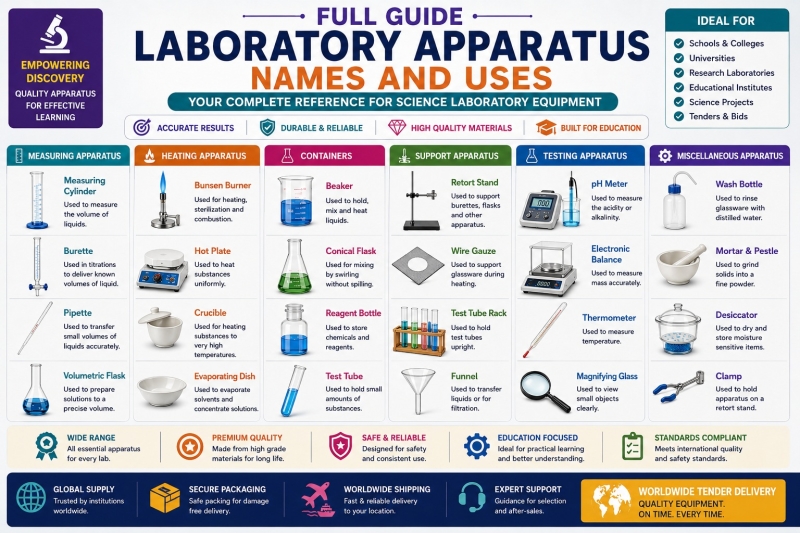
Laboratory apparatus is the collective term for the instruments, vessels, tools and fixtures used to conduct scientific experiments, measurements and analyses. The word covers everything from a two-rupee test tube to a spectrophotometer costing several lakhs.
People use “laboratory apparatus”, “lab equipment” and “scientific instruments” more or less interchangeably, though there is a soft distinction worth knowing:
- Apparatus usually implies the simpler physical items — glassware, stands, burners, clamps.
- Equipment or instruments leans towards the powered, calibrated and measuring devices — balances, microscopes, centrifuges, furnaces.
In practice nobody is strict about it, and procurement documents use all three terms in the same paragraph.
The seven categories of laboratory apparatus
Every item in a lab falls into one of these functional groups. Learning the groups is far more useful than memorising an alphabetical list, because when you are specifying a new lab you buy by group.
- Glassware and containers — hold, mix, transfer and store
- Supports, holders and clamps — position everything else safely
- Heating apparatus — apply controlled heat
- Measuring and weighing instruments — quantify mass, volume, temperature, dimension
- Separation, mixing and sample preparation — isolate and prepare what you are studying
- Analytical instruments — identify and characterise
- Safety equipment — protect the person doing the work
1. Glassware and containers
Laboratory glassware is the most visible part of any lab and usually the first thing that needs replacing. Almost all of it should be borosilicate 3.3 glass (the standard is ISO 3585 / ASTM E438 Type 1 Class A), which has a low coefficient of thermal expansion — around 3.3 × 10⁻⁶/K — and therefore survives being heated and cooled without cracking. Soda-lime glass is cheaper and perfectly fine for storage bottles and specimen jars, but it will fail on a hot plate. If a supplier will not tell you which grade you are getting, that is your answer.
Beaker
A cylindrical, flat-bottomed vessel with a lip for pouring. Used for holding, mixing, heating and rough volume estimation. The graduations printed on the side are approximate — typically ±5% — so never use a beaker where accuracy matters.
Standard sizes run 25 ml to 5,000 ml. A working school lab needs 100, 250 and 500 ml in quantity; the very large sizes get bought once and used twice a year.
Conical flask (Erlenmeyer flask)
Cone-shaped body, narrow neck, flat base. The shape lets you swirl the contents vigorously without spilling, which is why it is the standard vessel for titration. The narrow neck also slows evaporation and takes a stopper or cotton plug — hence its use in microbiology for culture media.
Volumetric flask
A pear-shaped flask with a long narrow neck carrying a single etched graduation mark. Used to prepare solutions of precise concentration. You fill to the mark and no further; the narrow neck means a small error in height is a very small error in volume. Class A volumetric flasks are individually calibrated and carry a tolerance — a 250 ml Class A flask is accurate to ±0.15 ml.
Round bottom flask
Spherical base, used for heating liquids and for distillation and reflux. The curved base distributes heat evenly and withstands vacuum, but it will not stand up on its own, so it needs a cork ring or a clamp. Available with one, two or three necks for setups requiring a thermometer, condenser and dropping funnel simultaneously.
Test tube
The workhorse. A small cylindrical tube for holding, mixing and heating small quantities. Standard sizes are quoted as diameter × length in mm — 12×75, 16×150, 25×150 being common. Rimmed tubes are easier to pour from; unrimmed take a stopper more neatly.
Boiling tube
A larger, thicker-walled test tube designed to take direct flame. If your students are cracking test tubes over a Bunsen burner, you have bought the wrong item.
Measuring cylinder (graduated cylinder)
A tall narrow cylinder for measuring liquid volume with reasonable accuracy — better than a beaker, worse than a pipette or burette. Read the bottom of the meniscus at eye level. Available in glass and polypropylene; the plastic ones are the sensible choice for school labs because the tall thin shape makes glass ones fragile.
Burette
A long graduated glass tube with a stopcock at the bottom, used to deliver precise, variable volumes during titration. Standard capacity 50 ml with 0.1 ml graduations. Two stopcock types: glass, which needs greasing and must never be used with alkali (it seizes), and PTFE, which needs no grease and handles alkali fine. Buy PTFE.
Pipette
For transferring precise volumes.
- Volumetric (bulb) pipette — delivers one fixed volume, very accurately.
- Graduated (Mohr) pipette — delivers variable volumes, less accurately.
- Micropipette — an adjustable, air-displacement instrument using disposable plastic tips, for microlitre volumes. Essential in any biology or biotech lab. Needs annual calibration.
- Pasteur pipette — a simple dropper, glass or plastic, for transfers where volume does not matter.
Funnel
Cone with a stem, for transferring liquids or powders into narrow-necked containers, and for gravity filtration when lined with filter paper. Short-stem funnels for powders, long-stem for liquids.
Separating funnel
A pear-shaped or conical funnel with a stopcock at the bottom and a stopper at the top, used to separate two immiscible liquids — the classic organic-layer-and-aqueous-layer separation. You let the layers settle, then run off the lower one.
Watch glass
A shallow circular concave glass disc. Used to hold small solid samples, to cover a beaker loosely during heating, to evaporate small volumes of liquid, and to weigh solids on a balance. One of the most common questions we get is what a watch glass is actually for, and the honest answer is that it is a lid, a dish and a weighing boat depending on the day.
Petri dish
A shallow flat cylindrical dish with a loose-fitting lid, for culturing microorganisms on agar. Glass ones are autoclavable and reusable; plastic ones come pre-sterilised and disposable. Standard diameter 90 mm.
Reagent bottle
Storage for chemicals. Narrow-mouth for liquids, wide-mouth for solids. Amber glass for light-sensitive reagents. Ground-glass stoppers for volatiles, screw caps for everything else.
Desiccator
A thick-walled glass or polycarbonate chamber with a ground rim and a lid, containing a drying agent (usually silica gel) in the base below a perforated plate. Used to cool hot crucibles without them absorbing atmospheric moisture, and to store hygroscopic samples. Vacuum desiccators have a stopcock in the lid.
Condenser
A glass tube within a water-jacketed outer tube, used in distillation and reflux to cool vapour back into liquid. The Liebig condenser (straight inner tube) is standard; Allihn and coil condensers offer more surface area for reflux.
Crucible and lid
A small ceramic, porcelain or silica cup for heating solids to very high temperature — ashing, ignition, gravimetric analysis. Porcelain to about 1,100 °C; silica higher; platinum crucibles for the most demanding analytical work where nothing may leach into the sample. platinum labware
Capillary tube
A very fine-bore glass tube. Used for melting point determination (a sample is packed into one end and heated alongside a thermometer), for capillary action demonstrations, and in viscometry.
Read the full guide: Laboratory Glassware List — Every Type, Name and Use
2. Supports, holders and clamps
Unglamorous, cheap, and the reason experiments do not end up on the floor.
Retort stand (ring stand)
A heavy cast iron base with a vertical steel rod. Everything else clamps to it. Base weight matters more than anything — a light base with a tall clamped flask will tip. Look for 150 × 90 mm cast iron minimum for school use.
Boss head (clamp holder)
The right-angle connector that attaches a clamp to the stand rod. Sold separately from clamps, and always the first thing a lab runs out of. Buy twice as many as you think.
Burette clamp
A double-jaw clamp designed to hold a burette vertically without over-tightening. Some models hold two burettes for comparative titration.
Utility clamp (three-finger clamp)
Adjustable jaws, usually cork or rubber lined, for holding flasks, condensers and test tubes at any angle.
Test tube rack
Holds test tubes upright. Wood, plastic or stainless steel. Wooden racks warp with repeated autoclaving; polypropylene racks are autoclavable and are the better school buy.
Test tube holder
A spring-loaded wooden or metal tong for holding a single test tube while heating it.
Tripod stand
A three-legged iron stand that supports a beaker or flask over a Bunsen burner.
Wire gauze
A square of wire mesh, sometimes with a ceramic centre, placed on the tripod to distribute the flame’s heat evenly and prevent the glass cracking from a hot spot. Note: older gauzes had asbestos centres. If you have any of these in stock, dispose of them properly and replace them with ceramic-centred gauze.
Pipeclay triangle
A triangle of wire with ceramic sleeves, used to support a crucible on a tripod.
Crucible tongs and beaker tongs
For handling hot items. Crucible tongs have small curved tips; beaker tongs have wide rubber-lined jaws.
Forceps
Fine tweezers for handling small solids, filter papers and biological specimens.
3. Heating apparatus
Bunsen burner
A gas burner producing a single open flame with an adjustable air collar. Collar closed gives a luminous, cool, safety flame around 300 °C; collar open gives a roaring blue flame reaching about 1,500 °C at the tip of the inner cone. Requires a piped gas supply, which many schools no longer have.
Spirit lamp
A glass or metal reservoir with a wick, burning methylated spirit. The standard alternative where there is no gas line. Lower temperature than a Bunsen burner but adequate for most school chemistry.
Hot plate and hot plate magnetic stirrer
An electrically heated flat surface, usually ceramic or aluminium. The magnetic stirrer variant has a rotating magnet under the plate that spins a PTFE-coated stir bar in the vessel — heating and stirring in one instrument. This is the single most useful upgrade for a lab still working with burners.
Water bath
A container of heated water providing gentle, uniform, controlled heat below 100 °C. Essential for temperature-sensitive reactions and for enzyme work. Serological water baths hold ±0.5 °C; precision units hold ±0.1 °C.
Heating mantle
A flexible fabric-covered heating element shaped to fit a round bottom flask. Safer than an open flame for flammable solvents, and it heats the whole curved surface evenly.
Hot air oven
A thermostatically controlled chamber for drying glassware and samples and for dry-heat sterilisation, typically 50–250 °C. Standard in every lab.
Muffle furnace
A high-temperature chamber furnace, typically 900–1,200 °C, with the heating elements isolated from the chamber so combustion products do not contaminate the sample. Used for ashing, ignition, heat treatment and ceramics work.
4. Measuring and weighing instruments
Analytical balance
A precision balance reading to 0.0001 g (0.1 mg), enclosed in a draught shield. Non-negotiable for quantitative chemistry. Must sit on a vibration-free bench, away from air conditioning vents, and be levelled and calibrated regularly with certified weights.
Precision / top-loading balance
Reads to 0.01 g or 0.001 g, no draught shield, much faster to use. Correct choice for general weighing where the fourth decimal place is not needed.
Triple beam balance
A mechanical balance reading to 0.1 g. No power required, essentially indestructible, and still the right answer for a school lab with unreliable electricity.
Thermometer
Mercury-in-glass thermometers are being phased out worldwide under the Minamata Convention; specify spirit-filled or digital thermometers for new purchases. Standard laboratory range −10 to 110 °C with 1 °C divisions; specialist ranges to 360 °C.
Vernier caliper and micrometer screw gauge
Dimensional measurement in physics and engineering labs. A vernier caliper reads to 0.02 mm and measures internal, external and depth dimensions. A micrometer reads to 0.01 mm with a vernier scale extending it to 0.001 mm, over a much smaller range.
Stopwatch
Digital, 1/100 second resolution. Buy several. They disappear.
pH meter
An electrode-based instrument giving pH to ±0.01, far more accurate than indicator paper. The electrode is a consumable — it has a working life of one to two years and must be stored wet in KCl solution, never dry. Most “broken” pH meters are actually dead electrodes.
Measuring devices for volume
Covered above: measuring cylinder for rough work, pipette and burette for accurate work, volumetric flask for solution preparation.
5. Separation, mixing and sample preparation
Centrifuge
Spins samples at high speed to separate components by density. A clinical centrifuge running at 3,000–5,000 rpm handles blood and urine samples; a high-speed refrigerated centrifuge running to 20,000 rpm handles cellular and molecular work. Always balance opposite tubes to within 0.1 g — an unbalanced rotor is genuinely dangerous.
Filtration apparatus
Gravity filtration uses a funnel and folded filter paper. Vacuum filtration uses a Buchner funnel and flask connected to a pump, which is dramatically faster and gives a drier solid.
Distillation apparatus
A round bottom flask, still head, thermometer, condenser and receiver, used to separate liquids by boiling point. Fractional distillation adds a packed column for closer-boiling mixtures.
Soxhlet extraction apparatus
Continuously extracts a compound from a solid using a recycling solvent. Standard for fat and oil determination in food analysis.
Mortar and pestle
Grinding solids to powder. Porcelain for general use, agate for hard samples and where contamination must be minimised.
Magnetic stirrer and stir bars
Covered under hot plates above. Stir bars are PTFE-coated magnets, sized to the vessel.
Vortex mixer
Rapidly mixes the contents of a small tube by orbital shaking. One touch, two seconds, done.
Shaker and rotary shaker
Agitates multiple flasks or plates simultaneously. Orbital, reciprocating and rocking motions for different applications. Blood mixer rollers are a specialised version for gently mixing blood samples without haemolysis.
Sieve shaker and test sieves
Mechanically separates particles by size through a stack of graded sieves. Standard in soil, aggregate, cement, food and pharmaceutical labs. Sieve apertures follow IS 460 or ASTM E11.
Read the full guide: Civil Engineering Lab Equipment List
6. Analytical instruments
Microscope
- Compound microscope — two lens systems, typically 40× to 1000× magnification, for viewing cells and microorganisms on prepared slides.
- Stereo (dissecting) microscope — lower magnification, 10× to 40×, with a three-dimensional view and working distance, for dissection and specimen examination.
- Digital microscope — camera output to a screen, invaluable for teaching because the whole class sees the same field.
Spectrophotometer and colorimeter
Measures how much light of a given wavelength a solution absorbs, which by the Beer–Lambert law is proportional to concentration. A colorimeter uses coloured filters and covers the visible range; a UV-Vis spectrophotometer uses a monochromator and covers roughly 190–1100 nm.
Conductivity meter and TDS meter
Measures the electrical conductivity of a solution, used for water quality, salinity and purity testing.
Melting point apparatus
Heats a sample in a capillary tube at a controlled rate against a calibrated thermometer or digital sensor. Purity of an organic solid is judged by the sharpness of its melting range.
Viscometer
Measures a fluid’s resistance to flow. Capillary (Ostwald, Ubbelohde) viscometers for transparent Newtonian liquids; rotational viscometers for everything else. viscometers
Polarimeter
Measures the rotation of plane-polarised light by an optically active substance. Standard in sugar, pharmaceutical and essential oil analysis.
Autoclave
A pressure vessel that sterilises using saturated steam, typically 121 °C at 15 psi for 15–20 minutes. The only reliable way to sterilise media, glassware and biological waste. Vertical, horizontal and front-loading configurations.
Incubator
A temperature-controlled chamber for growing microbial and cell cultures, typically ambient +5 °C to 60 °C, with ±0.5 °C stability. CO₂ incubators add controlled carbon dioxide for mammalian cell culture.
Water distillation unit / water still
Produces distilled water for reagent preparation and glassware rinsing. Output rated in litres per hour. Deionisers and reverse osmosis units serve the same purpose by different means.
Electrophoresis apparatus and gel caster
Separates DNA, RNA or proteins by size through a gel under an electric field. The gel caster forms the gel; the tank and power supply run the separation.
7. Laboratory safety equipment
This section gets skipped in most lists, which is why it is here in full. Safety equipment is apparatus. It appears in every laboratory audit and every serious tender.
- Fume hood — a ventilated enclosure that draws vapours, fumes and dust away from the operator. Face velocity should be 0.4–0.6 m/s. Anything involving volatile or toxic chemicals belongs in one.
- Safety goggles — chemical splash goggles, not spectacles. They must seal against the face.
- Lab coat — cotton or cotton blend, full length, long sleeves. Synthetic fabrics melt.
- Gloves — nitrile for general chemical handling, latex for biological work, heat-resistant for hot items. Check the compatibility chart; no single glove resists everything.
- Eyewash station — must deliver 15 minutes of continuous flushing to both eyes, be reachable within 10 seconds of any hazard, and be flushed weekly.
- Safety shower — full-body drench for large chemical spills.
- Fire extinguisher — CO₂ for electrical and solvent fires, dry powder for general use. Never water in a chemistry lab.
- Fire blanket — for smothering small fires and clothing fires.
- First aid kit and chemical spill kit — stocked, in date, and located where everyone knows.
Read the full guide: Lab Consumables and Chemistry Lab Safety Equipment Checklist
50 common laboratory apparatus and their uses — quick reference
| # | Apparatus | Primary use |
|---|---|---|
| 1 | Beaker | Holding, mixing and heating liquids |
| 2 | Conical (Erlenmeyer) flask | Titration and swirling without spillage |
| 3 | Volumetric flask | Preparing solutions of exact concentration |
| 4 | Round bottom flask | Heating, distillation and reflux |
| 5 | Test tube | Small-scale reactions and heating |
| 6 | Boiling tube | Heating liquids directly over a flame |
| 7 | Measuring cylinder | Measuring liquid volume |
| 8 | Burette | Delivering precise variable volumes in titration |
| 9 | Volumetric pipette | Transferring one exact volume |
| 10 | Micropipette | Transferring microlitre volumes |
| 11 | Pasteur pipette | Dropwise transfer of liquids |
| 12 | Funnel | Transferring liquids and gravity filtration |
| 13 | Separating funnel | Separating immiscible liquids |
| 14 | Buchner funnel | Vacuum filtration |
| 15 | Watch glass | Covering, evaporating and weighing small samples |
| 16 | Petri dish | Culturing microorganisms |
| 17 | Reagent bottle | Chemical storage |
| 18 | Desiccator | Cooling and storing samples moisture-free |
| 19 | Condenser | Cooling vapour back to liquid |
| 20 | Crucible | Heating solids to high temperature |
| 21 | Capillary tube | Melting point determination |
| 22 | Retort stand | Supporting clamped apparatus |
| 23 | Boss head | Connecting clamps to the stand |
| 24 | Burette clamp | Holding a burette vertically |
| 25 | Utility clamp | Holding flasks and condensers |
| 26 | Test tube rack | Storing test tubes upright |
| 27 | Test tube holder | Holding a tube while heating |
| 28 | Tripod stand | Supporting vessels over a burner |
| 29 | Wire gauze | Spreading flame heat evenly |
| 30 | Pipeclay triangle | Supporting a crucible |
| 31 | Crucible tongs | Handling hot crucibles |
| 32 | Forceps | Handling small solids and specimens |
| 33 | Bunsen burner | Producing a controlled open flame |
| 34 | Spirit lamp | Heating where no gas supply exists |
| 35 | Hot plate magnetic stirrer | Combined heating and stirring |
| 36 | Water bath | Gentle controlled heating below 100 °C |
| 37 | Heating mantle | Safe heating of round bottom flasks |
| 38 | Hot air oven | Drying and dry sterilisation |
| 39 | Muffle furnace | High-temperature ashing and ignition |
| 40 | Analytical balance | Weighing to 0.0001 g |
| 41 | Triple beam balance | Mechanical weighing to 0.1 g |
| 42 | Thermometer | Temperature measurement |
| 43 | Vernier caliper | Dimensional measurement to 0.02 mm |
| 44 | pH meter | Accurate pH measurement |
| 45 | Centrifuge | Separating components by density |
| 46 | Mortar and pestle | Grinding solids |
| 47 | Compound microscope | Viewing cells and microorganisms |
| 48 | Spectrophotometer | Measuring concentration by light absorption |
| 49 | Autoclave | Steam sterilisation |
| 50 | Fume hood | Extracting hazardous vapours |
Laboratory apparatus by subject
If you are equipping a school or college from scratch, you will be buying by department, not by function. Here is roughly how the list divides.
Chemistry laboratory apparatus
Glassware dominates: beakers, conical flasks, volumetric flasks, burettes, pipettes, reagent bottles, condensers and distillation sets. Add a Bunsen burner or hot plate at every bench, an analytical balance, a hot air oven, a pH meter, a fume hood, and reagent storage that meets your local chemical regulations.
Read the full guide: Chemistry Lab Apparatus and Equipment — Full List With Uses
Physics laboratory apparatus
Very different in character. Measurement and demonstration rather than glassware: vernier calipers, micrometers, travelling microscopes, spherometers, optical benches, lenses and prisms, resonance tubes, Young’s modulus apparatus, viscosity and surface tension apparatus, metre bridges, potentiometers, rheostats, galvanometers, DC regulated power supplies, and the various heat transfer and mechanics trainers used in engineering courses.
Read the full guide: Physics Lab Equipment List and Their Uses
Biology laboratory apparatus
Microscopes and slides above all, plus dissecting instruments, specimen jars, preserved biological specimens, anatomical and botanical models, incubators, autoclaves, centrifuges, Petri dishes and culture media, and electrophoresis equipment where the syllabus goes that far.
Read the full guide: Biology Lab Equipment — Specimens, Models and Histology Instruments
Materials and standards: what to check before you buy
A list of apparatus names is only half the specification. The other half is what it is made of and to what standard.
Glass. Insist on borosilicate 3.3 (ISO 3585, ASTM E438 Type 1 Class A) for anything that will be heated. Ask for the graduation tolerance class on volumetric ware — Class A or Class B — and ask whether Class A pieces come with individual certificates. They should.
Plastics. Polypropylene is autoclavable and chemically resistant but goes opaque. Polycarbonate is clear and strong but attacked by alkali and by repeated autoclaving. PTFE resists nearly everything and costs accordingly. Match the polymer to the chemistry.
Metals. Stainless steel 304 for general lab furniture and racks; 316 where chlorides or acids are present. Cast iron for stand bases, because weight is the point.
Calibration and certification. Balances, thermometers, pH meters, sieves and volumetric glassware should come with a calibration certificate traceable to a national standard. If you are buying for a lab that will be NABL or ISO 17025 accredited, this is not optional.
Electrical. Check the supply voltage and frequency, and specify it in the order. A 230 V / 50 Hz instrument shipped to a 110 V / 60 Hz country is an expensive paperweight. Also confirm the plug type.
After-sales. Ask about spares availability for the electrode, the heating element, the stopcock, the lamp. Instruments do not fail all at once; they fail one consumable at a time.
Setting up a new laboratory: what to buy in what order
A pattern we see repeatedly is a school spending its entire first-year budget on one impressive instrument and then having no consumables. The better sequence:
First, the bench and the safety layer. Benches, sinks, storage, fume hood, eyewash, extinguishers, first aid. Nothing else can be used safely without these.
Second, quantity items. Test tubes, beakers, conical flasks, measuring cylinders, funnels, stands, clamps, burners. Buy these in class-set quantities — enough for every student pair to have their own. Half a class watching the other half do an experiment is the commonest failure in practical teaching.
Third, one good balance and one good microscope rather than four mediocre ones.
Fourth, the specialist instruments the syllabus actually demands. Read the curriculum before you read the catalogue.
Fifth, consumables and a replacement budget. Assume 10–15% annual breakage on student glassware. If that is not in the budget, the lab quietly stops functioning in year two.
Common mistakes
Using a beaker as a measuring vessel. The graduations are indicative only. Use a cylinder or a pipette.
Greasing a PTFE stopcock. It does not need it, and grease contaminates your titrant.
Heating a volumetric flask. It is calibrated at 20 °C. Heating changes the glass volume and destroys the calibration permanently.
Storing a pH electrode dry. It kills the electrode. Store it in the manufacturer’s storage solution or 3M KCl.
Autoclaving something sealed. Pressure equalisation matters. Loosen caps.
Leaving a mercury thermometer in service. Replace them. Beyond the regulatory position, a broken mercury thermometer closes a lab for a day.
Buying by price per unit without checking glass grade. The soda-lime beaker is 40% cheaper and will crack on its third heating.
Frequently asked questions
What is laboratory apparatus? Laboratory apparatus is the collection of instruments, vessels, tools and fixtures used to carry out scientific experiments, measurements and analysis. It ranges from simple glassware such as beakers and test tubes to powered instruments such as centrifuges, spectrophotometers and autoclaves.
What are the basic laboratory apparatus every lab needs? The core set is: beakers, conical flasks, test tubes and rack, measuring cylinder, funnel, pipette, burette, retort stand with clamps, tripod and wire gauze, a heat source (Bunsen burner or hot plate), a balance, a thermometer, and the safety layer of goggles, lab coat, gloves, eyewash and fire extinguisher.
What is the difference between laboratory apparatus and laboratory equipment? The terms overlap heavily. “Apparatus” is generally used for simpler, unpowered items such as glassware, stands and clamps, while “equipment” or “instruments” tends to describe powered and calibrated devices such as balances, microscopes and furnaces. In tenders and catalogues the words are used interchangeably.
Which laboratory equipment is used to test the structure of a water molecule? No single common laboratory instrument determines molecular structure directly. Molecular geometry is established using spectroscopic and diffraction techniques: infrared and Raman spectroscopy identify the bond vibrations and confirm the bent shape, microwave rotational spectroscopy yields the bond length (about 0.096 nm) and bond angle (about 104.5°), and X-ray or neutron diffraction determines structure in the solid state. In a school laboratory the structure is demonstrated using molecular models rather than measured.
What are the names of the glass apparatus in a laboratory? Beaker, conical flask, volumetric flask, round bottom flask, test tube, boiling tube, measuring cylinder, burette, pipette, funnel, separating funnel, watch glass, Petri dish, reagent bottle, desiccator, condenser and capillary tube are the standard glass items.
What apparatus is used for measuring in a laboratory? Volume is measured with a measuring cylinder, pipette, burette or volumetric flask; mass with an analytical, precision or triple beam balance; temperature with a thermometer; dimension with a vernier caliper or micrometer; time with a stopwatch; and acidity with a pH meter.
How many laboratory apparatus are there? There is no fixed number. A functioning school science laboratory typically uses 50 to 80 distinct items; a university or industrial testing laboratory may use several hundred. The list in this guide covers the items you will encounter in the great majority of labs.
What should I look for when buying laboratory apparatus? Glass grade (borosilicate 3.3 for anything heated), graduation tolerance class on volumetric ware, calibration certificates traceable to a national standard, correct supply voltage and plug type for your country, availability of spares and consumables, and a supplier who will answer a technical question rather than send a price list.
Getting the specification right
Most laboratory purchasing goes wrong at the specification stage rather than the buying stage. A tender that says “50 beakers” invites the cheapest soda-lime glass available. A tender that says “50 beakers, low form with spout, borosilicate 3.3 to ISO 3585, 250 ml, graduated” gets you something that lasts a decade.
Naugra Export manufactures and supplies the full range of laboratory apparatus covered in this guide — glassware, physics and chemistry lab instruments, biology models and specimens, testing equipment and complete laboratory furniture — to schools, universities, research institutes and industrial laboratories in more than 90 countries. If you are preparing a laboratory specification or a tender document, send us the syllabus or the scope and we will help you build the item list.
Browse all laboratory equipment categories · Request a quotation
Specifying a laboratory or preparing a tender?
Send us your syllabus, scope or BOQ. We will build the item list with the grades, standards and calibration requirements stated against each line, so the quotation you receive is comparable.
Bulk supply and tender enquiries
Everything in this guide is manufactured in our own unit and supplied in bulk to schools, colleges, contractors and government tenders in over 90 countries. Browse the range, or send us a BOQ and we will quote against it line by line.