
Civil Engineering Lab Equipment List
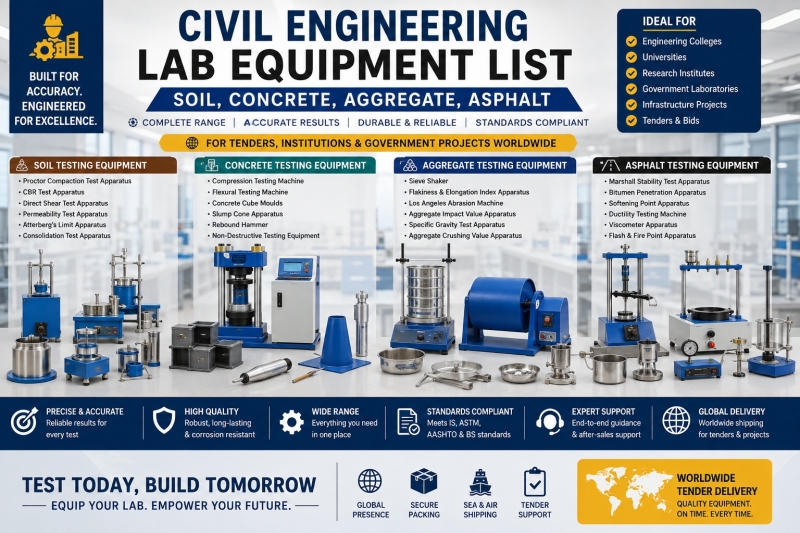
Civil Engineering Lab Equipment List: Soil, Concrete, Aggregate, Asphalt - A civil engineering laboratory is different from a school science lab in one important way: the result has to stand up in a contract.
When a compression test says a concrete cube reached 32 N/mm², somebody is going to pour a slab on the strength of that number. Which is why every item below is specified against a standard, and why calibration certificates matter more here than anywhere else in a laboratory.
This is the complete civil engineering and construction laboratory equipment list, organised by the material being tested. We manufacture and export the full range from Ambala, India, to engineering colleges, contractors, ready-mix plants and government testing laboratories.
Start with the standard, not the item
The most common mistake in a civil lab tender is listing equipment without naming the standard it must satisfy.
“Liquid limit apparatus” could be a Casagrande cup or a cone penetrometer — they give different numbers and different countries mandate different ones. “Compression testing machine, 2000 kN” says nothing about the required accuracy class or platen flatness.
Quote every line against IS, ASTM, BS or EN as your jurisdiction requires. Then specify:
- Capacity and accuracy class on any load frame
- Calibration certificate traceable to a national standard on load frames, proving rings, sieves, balances, thermometers and moulds
- Supply voltage, frequency, phase and plug type on anything electrical
If the laboratory will be NABL or ISO 17025 accredited, traceable calibration is not a preference. It is the condition of accreditation.
Soil testing equipment
The largest group in most civil laboratories, and the one where sample preparation apparatus is most often forgotten.
Classification and index properties
Sieve sets and sieve shaker — test sieves in 200 mm and 300 mm diameter, brass or stainless frames, apertures to IS 460 or ASTM E11. A mechanical sieve shaker with a timer removes the operator variation that hand sieving introduces.
Liquid limit apparatus — the Casagrande cup with grooving tool, or a cone penetrometer. State which your standard requires.
Plastic limit set — glass plate and rolling apparatus.
Shrinkage limit apparatus — shrinkage dish, glass cup and plate.
Hydrometer analysis set — hydrometer, sedimentation jars, dispersing agent and a constant temperature bath, for particles finer than 75 microns.
Pycnometer and density bottles — specific gravity determination.
Field density apparatus — core cutter with dolly and rammer, and sand replacement apparatus with a pouring cylinder and calibrating can.
Compaction and CBR
Proctor compaction apparatus — standard and modified moulds with collars, base plates and rammers of 2.6 kg and 4.89 kg. Confirm which rammer weight and drop height your standard specifies; they differ between IS and ASTM.
CBR test apparatus — CBR mould with collar and spacer disc, surcharge weights, penetration plunger, and a loading machine giving a controlled 1.25 mm/min penetration rate.
Swell and soaking apparatus — expansion measuring device and soaking tank.
Shear strength
Direct shear test machine — determines shear strength parameters c and φ by shearing a 60 × 60 mm sample under a normal load. Available in hand-operated and motorised form with strain-controlled drive. The motorised version with a load cell and displacement transducer is worth the difference in a teaching lab, because it removes the crank-rate variation that makes student results irreproducible.
Triaxial test apparatus — cell, loading frame, pressure system and volume change device. Unconsolidated undrained, consolidated undrained and consolidated drained tests. The most capable soil shear test and the most demanding to run.
Unconfined compression test machine — measures the unconfined compressive strength of a cohesive soil sample with no lateral confinement. Available motorised and hand-operated, typically with proving ring load measurement and a dial gauge for deformation. Fast, simple, and the standard quick strength check on a cohesive soil.
Vane shear apparatus — laboratory and field versions for very soft clays.
Consolidation and permeability
Consolidation (oedometer) apparatus — consolidation cell, loading frame with lever arm, weights and dial gauge, for settlement prediction.
Permeability apparatus — constant head permeameter for coarse soils and falling head permeameter for fine soils.
Agricultural soil testing
A separate discipline from geotechnical soil testing, and often ordered under the same heading by mistake. Agricultural soil testing lab equipment covers soil pH meters, EC and conductivity meters, flame photometers for potassium and sodium, spectrophotometers for phosphorus and nitrogen, Kjeldahl nitrogen apparatus, soil augers and samplers, drying ovens, and complete soil health testing kits.
If your tender says “soil testing equipment” and you mean fertility rather than bearing capacity, say so — the two lists have almost nothing in common.
Cement testing equipment
Vicat apparatus — initial and final setting time, and standard consistency, with the appropriate needles and plunger.
Le Chatelier apparatus — soundness by expansion, with the water bath to go with it.
Blaine air permeability apparatus — fineness by specific surface area.
Mortar cube moulds — 70.6 mm for IS work, 50 mm for ASTM.
Flow table and mortar mixer — for consistent mortar preparation.
Compression testing machine — for mortar cubes, typically 250 kN to 500 kN capacity.
Autoclave — accelerated soundness testing.
Cement testing equipment list, minimum: Vicat apparatus, Le Chatelier apparatus and water bath, standard sieves, mortar cube moulds, mortar mixer, flow table, compression testing machine, balance, drying oven and curing tank.
Concrete testing apparatus
Fresh concrete
Slump cone with tamping rod and base plate — the universal workability test.
Compaction factor apparatus — for low workability mixes where slump gives no useful reading.
Vee-Bee consistometer — for very dry mixes.
Air entrainment meter — air content by pressure method.
Concrete mixer — laboratory pan or drum mixer, and a vibrating table for compacting specimens.
Hardened concrete
Compression testing machine — the centrepiece. Capacities from 1,000 kN to 3,000 kN, in manual, semi-automatic and fully automatic pace-rate-controlled versions. Automatic pace rate control matters more than most buyers expect: manual loading rate variation is a large source of scatter in cube results.
Cube and cylinder moulds — 150 mm and 100 mm cubes, 150 × 300 mm cylinders, cast iron or steel.
Beam moulds and flexural testing attachment — for modulus of rupture.
Curing tank with thermostatic control.
Cylinder capping set and compressometer/extensometer for elastic modulus.
Core drilling machine with diamond bits — for in-situ strength assessment.
Non-destructive testing: rebound (Schmidt) hammer for surface hardness, ultrasonic pulse velocity tester for voids and cracks, rebar locator and cover meter, and half-cell potential meter for corrosion assessment.
Permeability apparatus — water permeability of concrete, and RCPT for chloride penetration.
Aggregate testing equipment
Aggregate impact value apparatus — resistance to sudden shock.
Aggregate crushing value apparatus — resistance to gradually applied compressive load.
Los Angeles abrasion machine — abrasion resistance with the standard charge of steel spheres.
Elongation index gauge and flakiness index gauge — particle shape.
Specific gravity and water absorption apparatus — wire baskets, pycnometers and density baskets.
Sieve sets and shaker — grading analysis.
Bulk density measures and moisture content apparatus.
Riffle sample divider (the “iffle” divider) — the item that makes every other aggregate result valid. A bulk sample of aggregate segregates as soon as it is poured, with the coarse particles migrating to the edges. Quartering by hand gives an unrepresentative sub-sample. A riffle divider splits the sample repeatedly through alternating chutes so each half is genuinely representative of the whole.
Available in a range of chute widths — the rule is that the chute opening should be at least 1.5 times the largest particle in the sample. Get this wrong and the divider bridges and stops dividing.
Riffle sample divider for aggregate testing
Elutriator — separates fine particles from coarse using an upward flow of water or air. Particles whose settling velocity is lower than the upward flow velocity are carried away; heavier particles remain. Used for silt and clay content determination in fine aggregate and sand, for cement fineness work, and in soil particle size analysis. A simple apparatus that gives a cleaner separation of fines than wet sieving alone.
Asphalt and bitumen testing equipment
Penetrometer — penetration grade determination, the standard bitumen consistency test.
Ring and ball apparatus — softening point.
Ductility testing machine — with water bath and briquette moulds.
Flash and fire point apparatus — Cleveland open cup or Pensky-Martens.
Viscosity apparatus — Saybolt Furol and standard tar viscometers.
Marshall testing equipment — Marshall stability and flow apparatus with compaction pedestal, hammer, moulds, breaking head, flow meter and water bath. The standard mix design method for dense bituminous mixes, and one of the lowest-competition search terms in this whole cluster.
Bitumen extractor — centrifuge type, for binder content determination.
Asphalt coring equipment — core drilling machines with diamond bits for extracting field cores from a laid surface, plus core cutting and trimming saws.
Ovens, hot plates and thermostatic water baths — bitumen testing is temperature-critical throughout, and an oven that swings ±5 °C invalidates a penetration result.
Proving rings, load measurement and calibration
A proving ring is a calibrated steel ring that deflects a known amount under load, with a dial gauge across its diameter measuring that deflection. It converts a deflection reading into a force via a calibration constant supplied on its certificate.
Proving rings are used on CBR machines, unconfined compression testers, direct shear machines and compression frames. They are simple, need no power, and hold calibration well — which is why they remain standard equipment in laboratories where a load cell and amplifier would be a maintenance liability.
Specify: the capacity, the calibration certificate traceable to a national standard, and the recalibration interval. A proving ring without a current certificate produces numbers, not results.
Modern alternatives are load cells with digital indicators, which give faster reading and data logging, at the cost of needing a power supply and periodic electronic calibration.
Surveying instruments
Not strictly materials testing, but part of every civil engineering laboratory tender.
Dumpy and automatic levels, theodolites in vernier and digital form, total stations, plane tables and alidades, prismatic compasses, clinometers, levelling staves, ranging rods, chains and tapes, optical squares, plumb bobs and tripods.
Robust carrying cases matter more than the specification sheet suggests — surveying instruments are damaged in transit far more often than in use.
Setting up a civil engineering laboratory: what to buy first
First, the load frames. A compression testing machine and a CBR/UCS loading frame are the two items everything else feeds. They are also the longest lead time and the heaviest, so order them first and design the room around them.
Second, sample preparation. Sieves and shaker, riffle divider, mixer, moulds, curing tank, drying oven, balances. A laboratory that can test but cannot prepare a representative sample produces confident, wrong numbers.
Third, the index property apparatus. Vicat, Le Chatelier, liquid and plastic limit, specific gravity, slump — the cheap items that make up most of the daily workload.
Fourth, the specialist rigs. Triaxial, consolidation, permeability, Marshall. Buy these against the specific syllabus or contract requirement rather than to fill a catalogue category.
Fifth, calibration and consumables. Certificates, filter papers, sample bags, dispersing agents, diamond bits, capping compound. And check the floor loading before the compression machine arrives — a 3,000 kN frame is not a bench instrument.
Frequently asked questions
What is included in a construction laboratory equipment list? A complete construction laboratory covers five groups: soil testing (sieves, compaction, CBR, shear, consolidation, permeability), cement testing (Vicat, Le Chatelier, mortar cubes, compression), concrete testing (slump, moulds, curing, compression, NDT), aggregate testing (impact, crushing, abrasion, shape, riffle divider) and asphalt testing (penetrometer, ring and ball, ductility, Marshall, extractor), plus surveying instruments, balances, ovens and calibration equipment.
What instruments are used in soil testing? For geotechnical soil testing: sieve sets and shaker, liquid and plastic limit apparatus, hydrometer set, pycnometer, core cutter and sand replacement apparatus, Proctor compaction apparatus, CBR apparatus, direct shear machine, triaxial apparatus, unconfined compression test machine, vane shear apparatus, consolidation apparatus and permeameters. Agricultural soil testing uses a different set entirely, based around pH meters, conductivity meters, flame photometers and spectrophotometers.
What is a direct shear test machine used for? A direct shear test machine determines the shear strength parameters of a soil — cohesion (c) and angle of internal friction (φ) — by shearing a sample along a predetermined horizontal plane under a known normal load. Testing at three or more normal loads gives the failure envelope. It is the simplest and fastest of the soil shear tests.
What is an unconfined compression test machine? An unconfined compression test machine measures the compressive strength of a cohesive soil sample with no lateral confinement applied. The sample is loaded axially until failure, and the unconfined compressive strength is used to estimate undrained shear strength as half that value. It is quick, needs no cell or pressure system, and only works on cohesive soils that hold their shape unsupported.
What is a proving ring and how does it work? A proving ring is a calibrated steel ring that deflects a predictable amount under an applied load. A dial gauge mounted across its diameter measures that deflection, which is converted into force using the calibration constant on the ring’s certificate. Proving rings are used on CBR, unconfined compression, direct shear and compression testing machines, and must be recalibrated periodically against a traceable standard.
What is an elutriator used for? An elutriator separates fine particles from coarse ones using an upward flow of water or air. Particles whose settling velocity is less than the upward flow velocity are carried out of the chamber, while heavier particles remain. It is used for determining silt and clay content in sand and fine aggregate, for cement fineness work, and in soil particle size analysis.
What is a riffle sample divider used for? A riffle sample divider splits a bulk sample of aggregate or soil into two representative halves by passing it through a series of alternating chutes. It is used because poured bulk material segregates by particle size, so simply scooping a sub-sample gives an unrepresentative result. The chute opening should be at least 1.5 times the largest particle size in the sample, or the divider will bridge.
What is Marshall testing equipment used for? Marshall testing equipment is used for the mix design and quality control of dense bituminous mixes. Compacted specimens are brought to test temperature in a water bath and loaded in a breaking head until failure, giving Marshall stability (the maximum load) and flow (the deformation at that load). The set comprises a compaction pedestal and hammer, moulds, breaking head, flow meter, loading machine and thermostatic water bath.
How should civil lab equipment be specified in a tender? State the applicable standard (IS, ASTM, BS or EN) against every item, the capacity and accuracy class on load frames, whether a traceable calibration certificate is required, and the supply voltage, frequency, phase and plug type on anything electrical. A line reading “compression testing machine, 2000 kN” invites the cheapest possible interpretation; naming the standard and the accuracy class does not.
Civil engineering lab equipment manufacturers and exporters in India
Naugra Export manufactures and supplies complete civil engineering and construction testing laboratories — soil, cement, concrete, aggregate, asphalt and surveying — to engineering colleges, contractors, ready-mix plants, highway authorities and government tenders in more than 90 countries. Every item is quoted against its applicable standard, with calibration certificates where the standard requires them.
Send your syllabus, scope or tender BOQ and we will build the item list with the standards stated, so the quotation you receive is directly comparable with every other one.
Browse civil and testing lab equipment · Concrete testing machines · Soil testing equipment · Read the pillar guide: Laboratory Apparatus Names and Uses · Request a quotation
Specifying a laboratory or preparing a tender?
Send us your syllabus, scope or BOQ. We will build the item list with the grades, standards and calibration requirements stated against each line, so the quotation you receive is comparable.
Bulk supply and tender enquiries
Everything in this guide is manufactured in our own unit and supplied in bulk to schools, colleges, contractors and government tenders in over 90 countries. Browse the range, or send us a BOQ and we will quote against it line by line.