
Biology Lab Specimens Models and Bulk Histology Instruments India
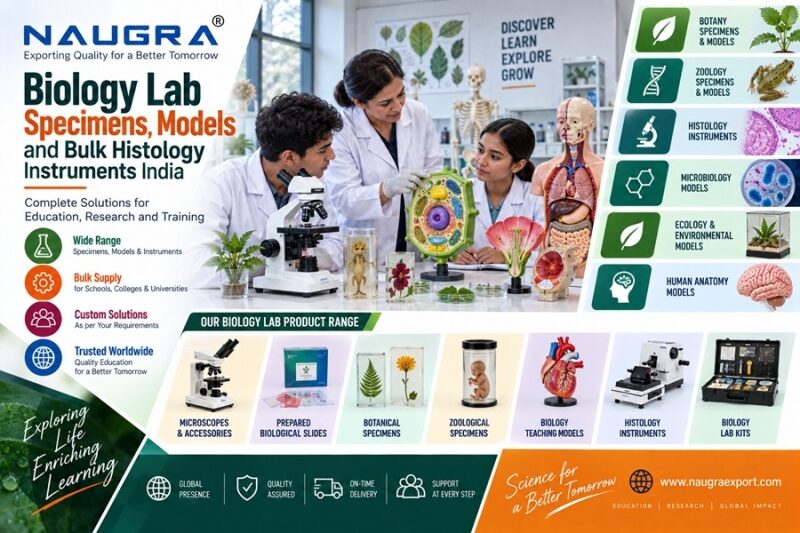
Biology departments buy three quite different things under one budget line. There are specimens, which are once-living material and have to be preserved, packed and cleared; there are models, which are manufactured teaching aids; and there is histology apparatus, which is laboratory machinery for preparing and examining tissue sections. Tenders that treat them as a single category usually go wrong somewhere, because the lead times, the documentation and the storage requirements are not the same. This guide separates them and explains what bulk supply from India involves for each.
Specimens: what to ask for and what to check
Preserved specimens are supplied either in sealed jars of fluid or as dry mounted material. The essentials for a secondary school are the dissection series — earthworm, cockroach, frog, fish, rat — plus a set of comparative anatomy jars covering the organ systems. Universities and medical colleges add embryology series, skeletal preparations and full-mount slides. Three things decide whether a specimen collection lasts: the preservative and whether it is formalin or a lower-hazard alternative, the seal on the jar, and the quality of the fixation itself, which determines whether structures are still distinguishable in five years. Our biology specimen range is prepared for teaching rather than research, meaning structures are fixed in positions that make them readable to a student holding the jar. Where a tender names a protected species, we say so and offer an alternative — the paperwork for protected material is rarely worth the teaching value, and a well-made model usually teaches the point better.
Models: where they beat the real thing
A good anatomical model outlasts every specimen in the room and takes handling that would destroy a preparation. The core human series covers a torso in parts, skeleton, skull, heart, brain, eye, ear, kidney, lung and the digestive tract, with the dismountable versions earning their price because students can take them apart. Our human anatomy models are made from moulded plastic on a stand, numbered and supplied with a key card. Botany is the half most tenders underbuy: flower structure, root and stem sections, leaf anatomy, pollination and the life cycles of fern, moss and angiosperm all teach far better from an enlarged model than from a chalk diagram, and our botany and plant models cover that syllabus directly. Charts belong here too, and their virtue is that they cost little and survive everything.
Histology instruments: the machinery half
Histology turns tissue into a stained section on a slide, and each stage needs its own instrument. Fixation and processing come first, through a tissue processor that takes samples through graded alcohols and clearing agents into wax. Embedding follows at a paraffin embedding station with a cold plate. Sectioning is done on a rotary microtome, with a cryostat where frozen sections are required, and the section is floated out on a tissue flotation bath before mounting. Staining runs through a staining set or an automatic slide stainer, and the finished slide is covered and labelled. Around that sit the consumables that tenders routinely omit: cassettes, base moulds, microtome blades, slides, coverslips, mounting medium and the stains themselves. A department buying a microtome without a flotation bath and a blade supply has bought an ornament, so we quote the chain rather than the item.
Microscopes: the instrument everything else depends on
None of the above teaches anything without microscopes in working order. For schools, a monocular compound microscope with LED illumination and a mirror option is the practical choice in regions where power is intermittent, and a stereo microscope should be specified alongside for dissection and for botany. Colleges need binocular heads and, for histology, a teaching head or camera output so a class can see what one student is seeing. Prepared slides are worth buying in bulk from the outset: a class working through cell division needs enough mitosis slides for everyone to see a decent metaphase rather than a queue at one bench. Our microscopes and prepared slides range covers school through college use, and we supply spare bulbs and immersion oil as standard consumable lines because both run out first.
Bulk supply from India: packing, documents and lead times
Bulk biology orders are awkward to ship, and most of the difficulty is the specimens. Fluid-filled jars travel individually boxed inside crates with absorbent packing, labelled as preserved biological specimens with the preservative named on the documentation, and consignments are declared so that customs sees the contents before the container is opened. Models are light and bulky, which makes them cheap by weight and expensive by volume, so it is usually worth consolidating models with glassware or furniture rather than shipping them alone. Histology instruments are the long-lead items at six to eight weeks for anything with a motor and a controller. A realistic schedule for a mixed biology tender from India is six to eight weeks to manufacture and consolidate, then sea transit, with the whole cycle around three months to most African and Asian ports. Documentation is issued to line item: packing list, invoice, certificate of origin, and any conformity certificate the destination scheme requires.
Frequently asked questions
Are specimens supplied in formalin?
We use formalin where a preparation requires it and lower-hazard preservatives where they perform as well; the fluid is stated on the jar and on the packing list.
Can you match a tender that names a specific model number?
Send the document. We quote to your specification and mark clearly where we offer an equivalent, with the differences stated rather than buried.
What is the minimum order for bulk supply?
There is no fixed minimum, but shipping economics change sharply once you fill a container, and a mixed biology and glassware order usually reaches that point sooner than buyers expect.
Do histology instruments come with consumables?
Only if quoted. We list blades, cassettes, slides and stains as separate lines so the quantities are yours to set.
Do you supply spare parts later?
Yes, and we hold the common items for the instruments we manufacture. Do you handle installation and training? For turnkey laboratory projects, yes — see turnkey projects.
The full range sits under biology lab equipment. If you are drafting a BOQ, the department-wise specification guide shows how to structure it, and our tender team will quote line by line against your document.
Specifying a laboratory or preparing a tender?
Send us your syllabus, scope or BOQ. We will build the item list with the grades, standards and calibration requirements stated against each line, so the quotation you receive is comparable.
Bulk supply and tender enquiries
Everything in this guide is manufactured in our own unit and supplied in bulk to schools, colleges, contractors and government tenders in over 90 countries. Browse the range, or send us a BOQ and we will quote against it line by line.