
3 Types of Heat Transfer Explained
The three types of heat transfer at a glance
| Conduction | Convection | Radiation | |
|---|---|---|---|
| What moves | Energy, not matter | The fluid itself | Electromagnetic waves |
| Medium needed | Yes — solid, liquid or gas | Yes — a fluid | No |
| Works in a vacuum | No | No | Yes |
| Governed by | Fourier’s law | Newton’s law of cooling | Stefan-Boltzmann law |
| Depends on | Temperature gradient, area, conductivity | Fluid velocity, geometry, properties | Temperature to the 4th power, emissivity |
| Everyday example | Spoon heating in tea | Boiling water circulating | Warmth from the sun |
| Dominant in | Solids | Liquids and gases in motion | High temperatures, vacuum |
1. Conduction
Conduction is heat transfer through a material, or between materials in contact, without any bulk movement of the material itself.
Hold a metal spoon in hot tea and the handle warms. Nothing travels up the spoon — the atoms stay where they are. What moves is energy, passed along by two means: atoms vibrating more vigorously and jostling their neighbours, and in metals, free electrons carrying kinetic energy quickly through the lattice.
That second mechanism is why metals conduct so much better than anything else. The free electrons that make a metal electrically conductive also make it thermally conductive, and the two properties track each other closely — a relationship known as the Wiedemann-Franz law.
Fourier’s law
Q = −kA (dT/dx)
Where: - Q is the heat transfer rate, in watts - k is thermal conductivity, in W/m·K — a property of the material - A is the cross-sectional area, in m² - dT/dx is the temperature gradient, in K/m
The minus sign says heat flows down the temperature gradient, from hot to cold.
Thermal conductivity: the numbers worth knowing
| Material | k (W/m·K) |
|---|---|
| Silver | 429 |
| Copper | 401 |
| Aluminium | 237 |
| Steel (mild) | 50 |
| Stainless steel | 16 |
| Glass | 1.0 |
| Water | 0.6 |
| Brick | 0.7 |
| Wood | 0.15 |
| Fibreglass insulation | 0.04 |
| Still air | 0.026 |
Look at the bottom of that table. Still air is one of the best insulators available — about 16,000 times worse at conducting than copper. Every insulating material in your house works the same way: fibreglass, foam, wool, double glazing and a duvet all do one job, which is to trap air and stop it moving. The material itself is almost incidental; it is scaffolding for the air.
The moment that air can circulate, it stops being an insulator and starts being a convection current. Which is why a draughty loft with plenty of insulation still loses heat.
Worked example
A steel plate 10 mm thick with 0.5 m² area has one face at 100 °C and the other at 20 °C.
Q = kA(ΔT)/L = 50 × 0.5 × 80 / 0.01 = 200,000 W
Replace the steel with 10 mm of fibreglass:
Q = 0.04 × 0.5 × 80 / 0.01 = 160 W
Same thickness, same area, same temperature difference. A factor of 1,250 difference in heat loss.
2. Convection
Convection is heat transfer between a surface and a moving fluid, carried by the bulk motion of that fluid.
Strictly, convection is conduction plus advection: heat conducts from the surface into the fluid layer touching it, and then the fluid physically carries that energy somewhere else. Both parts are essential, which is why convection cannot happen in a solid.
Natural and forced convection
Natural (free) convection is driven by density differences. Heat a fluid and it expands, becomes less dense, and rises; cooler fluid sinks to replace it. That circulation is a convection current. It is what makes a radiator warm a room, what drives weather systems, and what happens in a pan of water before it boils.
Forced convection is driven by something external — a fan, a pump, wind. It is far more effective, because the fluid is replaced at the surface much faster.
The difference is large. A person in still air loses heat at a rate corresponding to a heat transfer coefficient of roughly 5 W/m²·K. Put a fan on them and it can rise above 25. This is wind chill, and it is also why blowing on hot soup works.
Newton’s law of cooling
Q = hA (Ts − T∞)
Where: - h is the convective heat transfer coefficient, in W/m²·K - A is the surface area - Ts is the surface temperature and T∞ the bulk fluid temperature
The catch with h
Unlike thermal conductivity, h is not a material property. It depends on the fluid, its velocity, the geometry of the surface, whether the flow is laminar or turbulent, and whether the fluid is changing phase. It has to be determined experimentally or from empirical correlations built on dimensionless groups — Nusselt, Reynolds, Prandtl and Grashof numbers.
Typical ranges:
| Situation | h (W/m²·K) |
|---|---|
| Natural convection, air | 2–25 |
| Forced convection, air | 25–250 |
| Natural convection, water | 50–1,000 |
| Forced convection, water | 100–15,000 |
| Boiling water | 2,500–100,000 |
| Condensing steam | 5,000–100,000 |
Boiling and condensation transfer enormous amounts of heat at nearly constant temperature, which is why almost every industrial heat exchanger, power station and refrigeration system uses a phase change somewhere.
The boundary layer
Right at a surface, the fluid is stationary — it sticks. That thin stagnant film is where conduction has to do all the work, and it is the main resistance to convective heat transfer. Everything that improves convection, from stirring to fins to turbulence, works by making that boundary layer thinner.
3. Radiation
Radiation is heat transfer by electromagnetic waves, and it needs no medium at all.
This is the one that reaches you across 150 million kilometres of empty space from the sun. It is also why you feel warmth from a fire on your face before the air around you has warmed, and why a vacuum flask still slowly loses heat despite having no air to conduct or convect through.
Every object above absolute zero radiates. You are radiating right now, at around 100 watts.
The Stefan-Boltzmann law
Q = εσA (T⁴ − Tsurr⁴)
Where: - ε is emissivity, between 0 and 1 - σ is the Stefan-Boltzmann constant, 5.67 × 10⁻⁸ W/m²·K⁴ - A is the surface area - T is absolute temperature, in kelvin — this is not optional
Why the fourth power changes everything
Radiation scales with T⁴. Double the absolute temperature and radiated power goes up sixteen times.
This is why radiation is negligible at room temperature and dominant in a furnace. A surface at 27 °C (300 K) radiates about 460 W/m². The same surface at 727 °C (1000 K) radiates about 56,700 W/m² — 123 times more, for a temperature that has not even quadrupled.
It is also why using Celsius here gives nonsense. A body at 0 °C radiates plenty; a body at 0 K radiates nothing. The equation only works in kelvin.
Emissivity
Emissivity is how well a surface radiates compared with a perfect black body.
| Surface | Emissivity |
|---|---|
| Matt black paint | 0.95 |
| Human skin | 0.98 |
| Brick, concrete | 0.90 |
| Oxidised steel | 0.80 |
| Glass | 0.92 |
| Polished aluminium | 0.05 |
| Polished silver | 0.02 |
A good emitter is also a good absorber — that is Kirchhoff’s law. Which is why a matt black surface both radiates and absorbs strongly, and a polished silver one does neither. It is exactly why the inside of a vacuum flask is silvered, and why emergency blankets are shiny.
Is there a fourth type of heat transfer?
A lot of people search for “4 types of heat transfer”, and there is a reason the question keeps coming up.
The standard answer is three. Conduction, convection and radiation is what every mainstream textbook and syllabus teaches, and it is what an examiner expects.
But two things get proposed as a fourth:
Advection. Some texts separate advection — the transport of heat by the bulk movement of a fluid from one place to another — from convection, treating convection as the combination of advection and conduction at the surface. This is common in meteorology and oceanography, where the horizontal transport of warm air or water over long distances genuinely is a different problem from surface heat exchange. It is a real distinction; it just is not usually counted as a separate mechanism in engineering.
Phase change (latent heat transfer). Boiling, condensation, melting and evaporation move very large quantities of heat at nearly constant temperature. Because the physics is quite different from single-phase convection, some courses treat it separately. Strictly it is still convection, with a phase change enhancing the heat transfer coefficient enormously.
For an examination, answer three. If asked to name a fourth, advection is the safer answer, with phase change as a supporting example.
Telling them apart: a worked scene
Put a metal saucepan of water on a gas hob. All three mechanisms are running at once.
- Radiation — the flame radiates to the underside of the pan. It also radiates to your hand held nearby.
- Conduction — heat passes through the metal base of the pan, and up the handle.
- Convection — water at the base heats, becomes less dense, rises; cooler water sinks to take its place. That circulation is what heats the whole pan rather than just the bottom layer.
- Phase change — once boiling starts, bubbles of vapour carry away latent heat at a rate no single-phase mechanism could match.
The plastic handle is there because plastic has a thermal conductivity around 0.2 W/m·K against the metal’s 50. The shiny outer surface reflects rather than absorbs. Both are deliberate engineering choices based on the mechanisms above.
How each mechanism is measured in a laboratory
Every heat transfer laboratory exists to let students measure these three rather than take them on trust.
Conduction — linear heat conduction apparatus with a heated and cooled section and interchangeable specimens; radial heat conduction discs; composite wall apparatus for series and parallel thermal resistance; thermal conductivity apparatus for metal rods, liquids, gases, insulating powder and lagged pipes.
Convection — natural convection apparatus for a vertical cylinder; forced convection apparatus with variable air velocity; pin-fin apparatus run in both natural and forced modes; heated plate apparatus; and boiling and condensation units covering dropwise and filmwise condensation and critical heat flux.
Radiation — Stefan-Boltzmann apparatus for determining the constant experimentally; emissivity measurement apparatus comparing black and grey surfaces; and thermal radiation benches with variable source-detector spacing to demonstrate the inverse square law.
Combined — parallel and counter-flow heat exchangers, shell and tube exchangers, plate heat exchangers and cooling tower test rigs, where effectiveness, NTU and LMTD are calculated from the student’s own temperature readings.
[→ Heat transfer lab equipment and training systems]
Frequently asked questions
What are the 3 types of heat transfer? The three types of heat transfer are conduction, convection and radiation. Conduction moves heat through a material by molecular and electron interaction without the material itself moving. Convection moves heat by the bulk motion of a fluid. Radiation moves heat by electromagnetic waves and requires no medium at all.
What are the three kinds of heat transfer with examples? Conduction: a metal spoon warming in a hot drink. Convection: water circulating in a pan as it heats, or a radiator warming a room. Radiation: warmth reaching you from the sun across empty space, or the heat you feel on your face from a fire.
Are there 4 types of heat transfer? The standard answer is three. Some texts add advection — the transport of heat by bulk fluid movement over distance — as a fourth, particularly in meteorology, treating convection as advection combined with surface conduction. Others separate phase change processes such as boiling and condensation. For examination purposes, conduction, convection and radiation remain the three.
Which type of heat transfer does not require a medium? Radiation. It travels as electromagnetic waves and works through a vacuum, which is how energy reaches the Earth from the sun. Conduction and convection both require a material medium.
What is the difference between conduction and convection? In conduction the material stays put and only energy moves through it, so it works in solids. In convection the fluid itself physically moves and carries heat with it, so it only works in liquids and gases. Convection is actually conduction at the surface combined with bulk fluid motion.
Why does radiation depend on the fourth power of temperature? The Stefan-Boltzmann law states that the power radiated per unit area is proportional to the fourth power of absolute temperature, Q = εσAT⁴. This arises from integrating Planck’s law of blackbody radiation across all wavelengths. The practical consequence is that radiation is negligible at room temperature and dominant at high temperatures — doubling the absolute temperature increases radiated power sixteenfold.
Why is still air a good insulator? Still air has a thermal conductivity of about 0.026 W/m·K, among the lowest of any common substance and roughly 16,000 times lower than copper. Insulating materials such as fibreglass, foam and wool work primarily by trapping air and preventing it from circulating. Once the air can move, convection begins and the insulating effect largely disappears.
What is emissivity? Emissivity is a value between 0 and 1 describing how effectively a surface radiates heat compared with a perfect black body. Matt black surfaces have emissivity around 0.95, while polished metals are as low as 0.02. By Kirchhoff’s law a good emitter is also a good absorber, which is why vacuum flasks are silvered internally and emergency blankets are reflective.
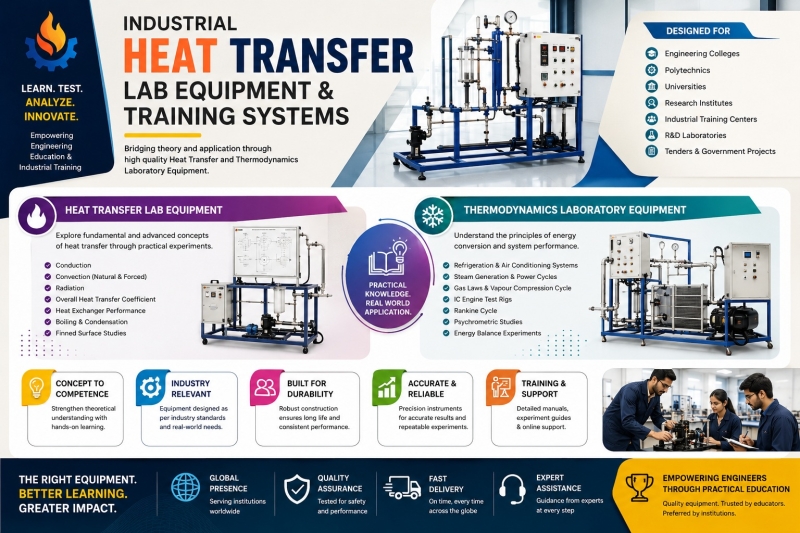
Heat transfer laboratory equipment from Naugra Export
Naugra Export manufactures and exports complete heat transfer laboratories — conduction, convection and radiation apparatus, heat exchangers, boiling and condensation units, instrumentation and benches — to engineering colleges, polytechnics, technical universities and TVET institutes in more than 90 countries. Every rig ships with an experiment manual covering theory, procedure and expected results.
Send your syllabus or tender BOQ and we will return a fully compliant quotation.
Heat transfer lab equipment · Thermodynamics laboratory equipment · Read the pillar guide: Laboratory Apparatus Names and Uses · Request a quotation
Specifying a laboratory or preparing a tender?
Send us your syllabus, scope or BOQ. We will build the item list with the grades, standards and calibration requirements stated against each line, so the quotation you receive is comparable.
Bulk supply and tender enquiries
Everything in this guide is manufactured in our own unit and supplied in bulk to schools, colleges, contractors and government tenders in over 90 countries. Browse the range, or send us a BOQ and we will quote against it line by line.