
Mechanical Components Parts Terms and Uses
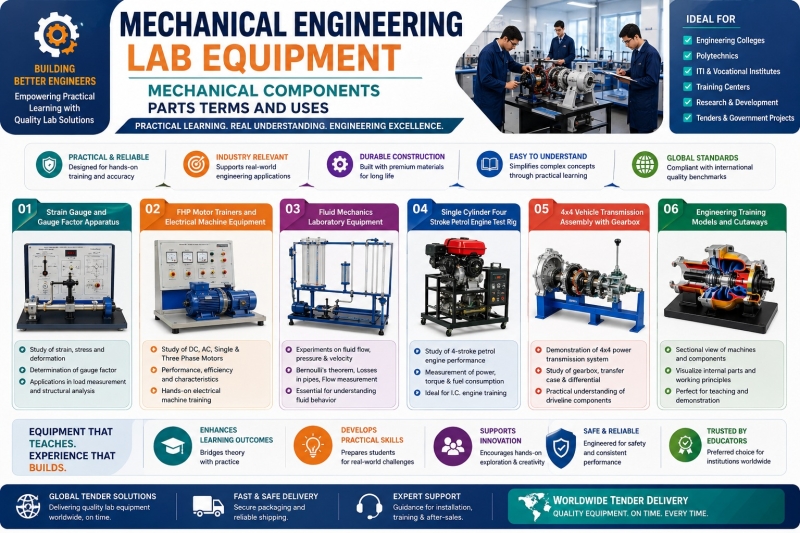
Mechanical Components and Their Uses - Mechanical engineering has a vocabulary problem in teaching. A student can name a gear and a bearing but stall on “backlash”, “interference fit” or “gauge factor” — terms that appear in every specification they will ever read.
This guide covers mechanical components and their uses, the terms that go with them, and the laboratory rigs used to teach how they behave. It is written for engineering students, technical instructors and anyone specifying equipment for a mechanical laboratory or workshop.
We manufacture and export mechanical engineering laboratory equipment, cutaway models and test rigs from Ambala, India.
The six families of mechanical components
Almost every mechanical part does one of six things. Learning the families beats memorising a parts list.
- Fasteners — hold things together
- Power transmission — move rotation from one place to another
- Bearings and guides — allow motion in one direction while preventing it in others
- Springs and dampers — store and dissipate energy
- Seals and gaskets — keep fluid in and contamination out
- Structural and machine elements — carry the loads
1. Fasteners
Bolts and screws. A bolt passes through a clearance hole and takes a nut; a screw threads into the component itself. Specified by diameter, pitch, length, head type and property class — an M10 × 1.5 × 50 hex bolt, class 8.8.
Nuts. Hex, nyloc (nylon insert, resists vibration loosening), castle (takes a split pin), wing (hand tightening), and lock nuts.
Washers. Plain washers spread the load. Spring and star washers resist loosening. A plain washer under a nut is not optional on soft materials — it is what stops the nut sinking in.
Rivets for permanent joints, pins — dowel, taper, split — for location and light load, and circlips and retaining rings to hold a bearing or shaft in place axially.
Keys and keyways. A parallel, gib-head or Woodruff key transmits torque between a shaft and a hub. The key is deliberately the weakest link: it shears before the shaft or the gear does.
Small mechanical components — pins, clips, keys, grub screws, spacers, shims — are the ones that go missing from a laboratory stock first and stop a rig being usable.
2. Power transmission components
Gears. Spur gears for parallel shafts, helical for parallel shafts with quieter running and higher load, bevel for intersecting shafts, worm and wheel for a large speed reduction in one stage with high self-locking, and rack and pinion to convert rotation to linear motion.
Key gear terms: module (the size of the tooth, and the thing that must match between meshing gears), pitch circle diameter, pressure angle (20° is the modern standard), and backlash — the deliberate clearance between meshing teeth, without which gears bind as they warm up.
Gear trains. Simple, compound, reverted and epicyclic (planetary). Epicyclic trains give a high ratio in a compact space and are what makes an automatic gearbox work.
Belts and chains. Flat, V and timing belts; roller and silent chains. Belts slip and that slip is sometimes useful as overload protection; chains do not slip and are used where timing matters.
Couplings and clutches. Rigid couplings for perfectly aligned shafts, flexible couplings to tolerate misalignment, universal joints for angular drive, and clutches — single plate, multi-plate, centrifugal — to connect and disconnect drive under load.
Shafts and axles. A shaft transmits torque; an axle carries load without transmitting torque. Both are sized by the greater of bending stress and torsional shear.
Cams and followers. Convert rotation into a defined reciprocating motion. The cam profile is the specification; the follower is knife-edge, roller or flat-faced.
Flywheels store rotational energy and smooth out the fluctuation between power strokes.
Governors — Watt, Porter, Proell, Hartnell — hold speed constant against load change.
3. Bearings and guides
Plain (journal) bearings — a shaft turning in a bush, separated by a lubricant film. Simple, quiet, tolerant of shock, and dependent on lubrication.
Rolling element bearings — deep groove ball (radial load, some axial), angular contact (combined loads), taper roller (heavy combined loads, used in pairs), cylindrical roller (high radial load), thrust (axial only), and needle roller (high radial load in a small radial space).
Linear guides and bushes for controlled straight-line motion.
Bearing selection is a trade-off between load, speed, alignment tolerance and life. The most common failure in a teaching laboratory is not overload — it is contamination and dry running.
4. Springs and dampers
Helical compression, extension and torsion springs, leaf springs, Belleville washers for high load in a short travel, spiral springs for clocks and instruments, and gas springs.
Springs are specified by stiffness (the rate, in newtons per millimetre), free length, solid length and maximum working load.
Dampers and shock absorbers dissipate energy rather than storing it. A suspension needs both: a spring to store, a damper to remove.
5. Seals and gaskets
O-rings — the most common seal, specified by inside diameter, cord thickness and material. Nitrile for oil, Viton for heat and chemicals, silicone for food and low temperature, EPDM for water and steam. Fitting the wrong elastomer is the commonest cause of a seal failing in weeks rather than years.
Lip seals (oil seals) for rotating shafts, mechanical seals for pump shafts, gaskets for static flanged joints, and circlip-retained seals in bearing housings.
6. Structural and machine elements
Frames, brackets, mountings and machine beds carry load and set alignment. Levers, linkages and four-bar mechanisms convert and amplify motion. Screws and lead screws convert rotation into precise linear travel — a ball screw does the same with far less friction.
Mechanical engineering terms worth knowing
A glossary of the terms that turn up in specifications and confuse students.
| Term | What it means |
|---|---|
| Backlash | Deliberate clearance between meshing gear teeth |
| Interference fit | The shaft is larger than the hole; assembly needs heat or force |
| Clearance fit | The shaft is smaller than the hole; parts assemble by hand |
| Transition fit | Between the two; may be either depending on tolerances |
| Tolerance | The permitted variation on a dimension |
| Allowance | The intended difference between mating parts |
| Preload | Load applied at assembly to remove clearance, common in bearings |
| Torque | A turning moment, in newton metres |
| Module | Gear tooth size; meshing gears must share a module |
| Pitch | Distance between repeating features — threads, teeth, chain links |
| Slenderness ratio | Effective length over radius of gyration; predicts buckling |
| Factor of safety | Design strength divided by expected working load |
| Stress and strain | Force per unit area; deformation per unit length |
| Young’s modulus | Stress over strain in the elastic region — material stiffness |
| Poisson’s ratio | Lateral strain over axial strain, about 0.3 for most metals |
| Fatigue | Failure from repeated loading well below the static strength |
| Creep | Slow deformation under sustained load at temperature |
| Hardness | Resistance to indentation — Brinell, Rockwell, Vickers |
| Toughness | Energy absorbed before fracture, measured by impact test |
| Gauge factor | Strain gauge sensitivity — see the section below |
Gauge factor: what it is and why it matters
Gauge factor is the sensitivity of a strain gauge. It is the ratio of the fractional change in electrical resistance to the mechanical strain that caused it:
GF = (ΔR / R) / ε
where ΔR/R is the fractional resistance change and ε is strain.
Typical values
- Metal foil gauges — gauge factor about 2.0 to 2.1. Constantan (copper-nickel) is the standard alloy because its gauge factor stays nearly constant over a useful strain range and its temperature coefficient is low.
- Semiconductor (piezoresistive) gauges — gauge factor 50 to 200. Far more sensitive, but strongly temperature dependent and non-linear, which is why they are used in transducers rather than general stress analysis.
- Platinum-tungsten alloys — around 4, used at high temperature.
Why 2 is the number to remember
For a metal, resistance changes with strain for two reasons: the wire gets longer and thinner (geometry), and its resistivity changes slightly (the piezoresistive effect). For most metals the geometric effect dominates and works out at approximately 1 + 2ν, where ν is Poisson’s ratio. With ν ≈ 0.3 that gives about 1.6, and the resistivity term takes it to roughly 2.
What is the gauge factor of a load cell?
A load cell does not have a gauge factor of its own — the term belongs to the individual strain gauges bonded to it, and those are typically 2.0 to 2.1.
What a load cell has instead is rated output or sensitivity, quoted in millivolts per volt of excitation at full scale. A common figure is 2 mV/V, meaning that with 10 V excitation the cell delivers 20 mV at its rated capacity. That is the number you use when sizing an amplifier, and confusing it with gauge factor is one of the more common errors in instrumentation coursework.
Strain gauge practicals
A gauge factor determination experiment bonds gauges to a cantilever or a proving ring, loads it in known increments, measures resistance change through a Wheatstone bridge, and calculates GF from the slope. The bridge configuration matters: a quarter bridge uses one active gauge, a half bridge two, and a full bridge four — with the full bridge giving four times the output and cancelling temperature effects.
Strain gauge and gauge factor apparatus
Fractional horsepower motors
A fractional horsepower (FHP) motor is any electric motor rated below one horsepower — under about 746 watts. The classification matters because FHP motors are designed and built differently from integral horsepower machines: they are usually single phase, often have no separate cooling fan, and their efficiency and starting characteristics are the teaching point.
Types found in an FHP motor laboratory
- Split phase induction motor — an auxiliary winding gives starting torque, switched out by a centrifugal switch. Low starting torque, cheap. Fans and small pumps.
- Capacitor start — a capacitor in the start winding improves starting torque considerably. Compressors, conveyors.
- Capacitor start capacitor run — better efficiency and power factor in operation.
- Permanent split capacitor — no switch to fail, modest starting torque. Fans and blowers.
- Shaded pole — simplest and cheapest, very low efficiency. Small fans and appliances.
- Universal motor — runs on AC or DC, very high speed, brushes. Power tools, vacuum cleaners, mixers.
- Stepper and servo motors — position control rather than continuous drive.
- FHP DC motors — shunt, series and compound.
What an FHP motor teaching set covers
No-load and blocked rotor tests, determination of equivalent circuit parameters, load characteristics, speed control methods, efficiency by direct loading and by loss segregation, starting torque comparison across types, and the effect of capacitor value on starting performance.
FHP motor trainers and electrical machine equipment
Test rigs used to teach mechanical components
Components are best taught on apparatus that lets students measure what the component actually does.
Theory of machines
Gear train models, cam and follower apparatus, governor apparatus (Watt, Porter, Proell, Hartnell), universal joint models, whirling of shafts apparatus, gyroscope apparatus, balancing of rotating and reciprocating masses apparatus, and journal bearing test rigs measuring pressure distribution around the bush.
Strength of materials
Universal testing machines for tension and compression, torsion testing machines, deflection of beams apparatus, buckling of columns apparatus, spring testing machines, hardness testers, impact testing machines, fatigue testing machines and creep test machines.
Fluid mechanics and machinery
Osborne Reynolds apparatus — the classic experiment where a dye filament is injected into a flow through a glass tube. At low velocity the filament stays as a straight line (laminar flow); as velocity rises it wavers and then breaks up completely (turbulent). Reynolds number is calculated from the flow rate, tube diameter and fluid viscosity, and the transition is found to occur around Re ≈ 2,000 to 4,000. It remains one of the most convincing demonstrations in an engineering laboratory because the result is visible rather than derived.
Also: Bernoulli’s apparatus, pipe friction rigs, impact of jet apparatus, pump and turbine test rigs, and hydraulic bench modules.
Fluid mechanics laboratory equipment
Automotive and thermal
Single cylinder four stroke petrol engine test rigs with dynamometer loading, fuel measurement, air box and full temperature instrumentation, used for performance testing, heat balance and volumetric efficiency determination.
Four wheel drive and 4x4 transmission assemblies with sectioned gearbox, transfer case and differential, used to teach power flow through a driveline in each gear and drive mode.
Both of these are covered in detail on their product pages — they are teaching rigs rather than components, and the specifications matter more than a summary can carry.
Single cylinder four stroke petrol engine test rig · 4x4 vehicle transmission assembly with gearbox
Cutaway and working models
Sectioned engines, gearboxes, pumps, valves, bearings and compressors, with cut faces colour-coded to a legend. A sectioned gearbox teaches power flow in five minutes where a diagram takes a lesson.
Engineering training models and cutaways
Specifying mechanical laboratory equipment
State the standard. Testing machines should be quoted against IS, ASTM, BS or EN, and load frames and proving rings need calibration certificates traceable to a national standard — mandatory for NABL or ISO 17025 accreditation.
Match capacity to teaching, not to industry. A 10 kN bench universal testing machine demonstrates tensile behaviour as well as a 1,000 kN floor frame and fits in a classroom.
Confirm the electrical supply. Voltage, frequency, phase and plug type on every order line. A 415 V three phase rig shipped to a 208 V country is an expensive paperweight.
Ask what is consumable. Strain gauges, adhesives, specimens, dye, bearings and belts are what a mechanical laboratory actually runs through. A rig whose consumables cannot be sourced locally becomes a display piece.
Require the manual. Every rig should ship with an experiment manual covering theory, procedure, sample readings and expected results, plus a spares list with part numbers.
Frequently asked questions
What are mechanical components? Mechanical components are the standard parts from which machines are built: fasteners such as bolts, nuts and keys; power transmission parts such as gears, belts, chains, shafts and couplings; bearings and guides; springs and dampers; seals and gaskets; and structural elements such as frames, levers and linkages. Almost every mechanical part performs one of those six functions.
What is the difference between a mechanical part and a mechanical component? In practice none — the terms are used interchangeably. “Component” is slightly more common in design and specification documents, and “part” in manufacturing and spares lists. Both refer to an individual item within a larger assembly.
What is gauge factor? Gauge factor is the sensitivity of a strain gauge: the fractional change in its electrical resistance divided by the mechanical strain that caused it, GF = (ΔR/R)/ε. Metal foil gauges have a gauge factor of about 2.0 to 2.1; semiconductor gauges range from 50 to 200 but are strongly temperature dependent.
What is the gauge factor of a load cell? A load cell has no gauge factor of its own — that property belongs to the strain gauges bonded to it, typically 2.0 to 2.1. A load cell is instead specified by rated output or sensitivity in millivolts per volt of excitation at full scale, commonly 2 mV/V.
What is a fractional horsepower motor? A fractional horsepower motor is any electric motor rated below one horsepower, roughly 746 watts. Common types include split phase, capacitor start, capacitor start capacitor run, permanent split capacitor, shaded pole and universal motors. They are usually single phase and are used in fans, pumps, appliances and power tools.
What is the Osborne Reynolds apparatus used for? Osborne Reynolds apparatus demonstrates the transition between laminar and turbulent flow. A fine dye filament is injected into water flowing through a glass tube; at low velocity it remains a straight line, and as velocity increases it begins to waver and then disperses completely. The Reynolds number at which this happens, typically between about 2,000 and 4,000, is calculated from flow rate, tube diameter and fluid viscosity.
What is backlash in gears? Backlash is the deliberate clearance between the teeth of meshing gears. It is designed in rather than a defect: without it, gears bind as they expand with temperature and as lubricant film builds. Too much backlash causes noise, shock loading on reversal and positional error in drives.
What is the difference between an interference fit and a clearance fit? In a clearance fit the shaft is smaller than the hole and the parts assemble by hand. In an interference fit the shaft is larger than the hole, so assembly requires force, or heating the outer part and cooling the inner. Interference fits transmit torque by friction alone and are used for gears, bearing races and pulleys on shafts.
Mechanical laboratory equipment manufacturers and exporters in India
Naugra Export manufactures and supplies complete mechanical engineering laboratories — theory of machines apparatus, strength of materials testing machines, fluid mechanics rigs, thermal engineering test rigs, automotive trainers, cutaway models and workshop equipment — to engineering colleges, polytechnics, TVET institutes and government tenders in more than 90 countries.
Send us your syllabus or tender BOQ and we will return a fully compliant quotation with the standards and calibration requirements stated against each item.
Browse mechanical engineering lab equipment · Read the pillar guide: Laboratory Apparatus Names and Uses · Request a quotation
Specifying a laboratory or preparing a tender?
Send us your syllabus, scope or BOQ. We will build the item list with the grades, standards and calibration requirements stated against each line, so the quotation you receive is comparable.
Bulk supply and tender enquiries
Everything in this guide is manufactured in our own unit and supplied in bulk to schools, colleges, contractors and government tenders in over 90 countries. Browse the range, or send us a BOQ and we will quote against it line by line.