
School Science Lab Supplies The Complete List
Prepared for school, college and technical-institute procurement teams · naugraexport.com
Start with the practicals, not the catalogue
Most lab budgets go wrong the same way: someone orders from a category list instead of from the syllabus. The result is three spectrometers and no spare test tubes.
Work backwards instead. Take the prescribed practical list for each grade you teach, write down every experiment, and note what each one needs and how many students perform it at once. A single Grade 9 density experiment run by 40 students in batches of 4 needs ten sets of the same apparatus, not one demonstration set. That multiplier is the difference between a lab that works and a lab where 36 students watch four students work.
Once the practical list is costed, come back to the department lists below and fill the gaps: the shared, general-purpose equipment that no single experiment demands but every experiment quietly assumes.
A lab isn’t a collection of instruments. It’s a set of experiments that can all run in the same period, for a full class, without borrowing from the next room.
PH — Physics lab equipment
Physics is the most apparatus-hungry department because its topics barely overlap. Mechanics needs mass and motion; optics needs a darkened bench; electricity needs supply, meters and safe wiring. Plan it as four sub-benches rather than one room.
Mechanics and measurement
- Mechanics laboratory equipment — inclined planes, pulley systems, trolleys, collision apparatus, spring balances
- Measurement instruments — vernier callipers, micrometer screw gauges, stopwatches, travelling microscopes
- Fluid mechanics apparatus — hydrometers, capillary tubes, viscosity and surface tension sets
- Meteorology and earth science — barometers, rain gauges, anemometers, hygrometers
Heat, light and sound
- Heat laboratory equipment — calorimeters, thermometers, conductivity apparatus, expansion sets
- Optical instruments — optical bench, lenses and mirrors, prisms, spectrometers, ray-tracing kits
- Sound apparatus — resonance tubes, tuning forks, sonometers
Electricity, electronics and modern physics
- Electricity laboratory instruments — rheostats, resistance boxes, decade boxes, galvanometers, meter bridges, potentiometers
- Electronics instruments — diodes, transistor characteristic kits, breadboards, regulated DC power supplies
- Electrostatic instruments — electroscopes, Van de Graaff generator, Leyden jars
- Modern physics — photoelectric effect apparatus, spectral lamps, Geiger counters, e/m apparatus
Quantity note: meters, stopwatches and callipers are the items you always under-order. Budget one per working group, plus 20% spares — they are the first things to be dropped, mislaid or damaged.
CH — Chemistry lab equipment
Chemistry splits cleanly into hardware that lasts a decade and consumables that vanish in a term. Order them on different cycles, or the consumables will eat the capital budget.
Bench hardware
- Burners — Bunsen burners, spirit lamps, tripod stands, wire gauzes, pipe clay triangles
- Retort stands and clamps — stands, bosses, burette clamps, ring clamps
- Basins and crucibles — evaporating basins, porcelain crucibles with lids, mortar and pestle
- Test tube stands, tongs, holders, brushes and racks
- Laboratory spatulas, scoops, deflagrating spoons and wire loops
- Heating and mixing — desiccators, water baths, hot plates, magnetic stirrers
Consumables and safety
- Filter papers in the grades your titrations and gravimetric work need
- Cork and tubing — rubber bungs, delivery tubes, silicone and rubber tubing
- Gas preparation sets — Kipp’s apparatus, gas jars, beehive shelves, troughs
- Chemistry lab safety equipment — goggles, aprons, gloves, fire blanket, sand bucket, eyewash and safety shower
- Fume hood or extraction for any work involving halogens, concentrated acids or hydrogen sulphide
Safety note: reagent storage is part of the equipment order, not an afterthought. Acids, bases, flammables and oxidising agents need separated, labelled, ventilated cabinets, and the chemistry room needs a written inventory that the lab assistant updates each term.
GL — Laboratory glassware
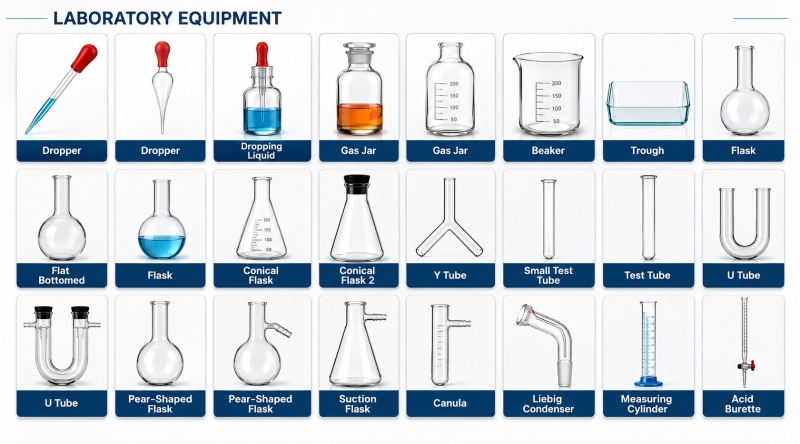
Buy borosilicate. Soda-lime glass is cheaper per beaker and more expensive per year, because it cracks on the first uneven heat. Buy in school-practical sizes rather than research sizes, and buy deep on the four items that break most: beakers, test tubes, measuring cylinders and funnels.
- Beakers — 50, 100, 250, 500 and 1000 ml
- Flasks — conical, round-bottom, flat-bottom, volumetric
- Burettes and pipettes — bulb and graduated
- Measuring cylinders — 10 to 1000 ml
- Test tubes, boiling tubes and Petri dishes
- Condensers — Liebig, spiral, air
- Fractionating columns and distillation sets
- Adapters and standard joints
- Reagent bottles with screw caps, amber and clear
- Stoppers, centrifuge tubes, watch glasses and glass rods
Ordering rule: anything that goes into a student’s hand should be ordered at class-set quantity plus a third. Anything used only by the teacher for demonstration can be ordered as a single unit.
BI — Biology lab equipment
Biology is model-heavy and slide-heavy. The specimens and models are what students remember, and they are what survives longest — a good torso model outlasts three sets of glassware.
- Human anatomy models — skeleton, torso, heart, eye, ear, brain, kidney, DNA helix
- Botany models — flower structure, leaf sections, plant cell, root systems
- Zoology models — amoeba, hydra, earthworm, frog, insect anatomy
- Educational charts for systems, cycles, classification and genetics
- Dissecting equipment — dissection trays, scalpels, forceps, needles, scissors, dissecting microscopes
- Microtomes and staining sets, stains and mounting media
- Slides and specimens — prepared slides, blank slides, cover slips, specimen jars
- Environmental instruments — soil test kits, water testing sets, light and pH meters
If your board permits it, replace animal dissection with high-quality models and virtual dissection software. It cuts recurring cost, removes the ethical objection, and lets every student do the exercise rather than watch it.
MS — Microscopes and optics
Microscope choice tracks the grade level, not the budget. Buying research-grade optics for a Grade 6 room is waste; buying elementary microscopes for a Grade 12 biology stream is a bottleneck.
|
Level |
What to buy |
|
Primary / middle |
Elementary monocular microscopes; stereo microscopes for whole specimens |
|
Secondary |
Laboratory monocular and binocular microscopes, 40× to 1000× |
|
Senior / college |
Research binocular and trinocular; phase contrast and fluorescence where the syllabus needs it |
|
Technical / metallurgy |
Metallurgical microscopes with reflected illumination |
|
Whole-class teaching |
Projection microscopes, or a camera-fitted trinocular head |
Order microscope accessories alongside: spare objectives, immersion oil, dust covers, lamp bulbs and lens tissue. A microscope out of service for a missing bulb is the most common avoidable loss in a school lab. Add telescopes if you run an astronomy or earth-science module.
MA — Mathematics lab
The maths lab is the cheapest department to equip and the most often skipped. Almost everything is a manipulative, so a full room costs less than two good microscopes.
- Base ten blocks and place-value sets
- Geometric shapes — solids, nets, transparent volume-comparison sets
- Mathematics kits for algebra tiles, fractions, probability and trigonometry
- Wooden maths products — abacus, geoboards, pattern blocks, Pythagoras and conic-section models
- Measuring and geometry sets, chart boards, graph and dot paper
EN — Engineering and technical education
For polytechnics, technical schools and college first-year labs, the unit of purchase changes: you are buying test rigs, each of which supports several prescribed experiments. Cost per rig is high, so map each rig against the number of experiments it covers before approving it.
Fluid mechanics and hydraulics
- Hydraulic bench — the base unit most other fluid experiments mount onto
- Pump test rigs — centrifugal pump, gear pump, jet pump
- Flow measurement rigs — orifice meter, nozzle meter, flow over notches
- Metacentric height apparatus and forced vortex apparatus
- Axial fan test rig
Thermal, process and energy
- Heat transfer training systems — conduction, convection, radiation, heat exchangers
- Thermodynamics lab equipment and refrigeration / air-conditioning test units
- Process units — open pan evaporator, multi-effect evaporator, packed distillation column, ion exchange unit
- Water cooler trainer and ice plant trainer
- Renewable energy lab equipment — solar PV and thermal trainers, wind turbine models
- Food technology and water treatment units for applied streams
Mechanics of machines
- Applied mechanics experiments — beam reactions, friction, moments, gear trains
- Theory of machines apparatus — governors, gyroscopes, cams, balancing rigs
TM — Testing machines
Materials testing is where a lab either gets certified or does not. Specify the load capacity against your syllabus, not against the biggest sample you can imagine.
- Universal testing machine — tension, compression, bending, shear
- Compression testing machine for concrete cubes and cylinders
- Spring testing machine
- Hardness testers — Rockwell, with Brinell and Vickers where required
- Impact testing machine — Izod and Charpy
- Torsion testing machine
- Measurement and analysis instruments for the materials bench
Ask for the calibration certificate and the traceability standard with the quotation, not after delivery. Also confirm the floor loading and power supply the machine needs — a UTM arriving at a first-floor lab with a three-phase requirement and no three-phase point is a common and expensive surprise.
CV — Civil engineering lab
Civil labs are built around material standards, so specify each item against the code your curriculum follows and check that the supplier quotes to the same one.
- Soil testing equipment — Proctor compaction, CBR, direct shear, consolidation, permeability, liquid limit
- Cement testing equipment — Vicat apparatus, Le Chatelier mould, flow table, mortar mixer
- Concrete testing equipment — cube and cylinder moulds, slump cone, vibrating table, curing tank
- Aggregate testing equipment — sieve sets, Los Angeles abrasion, impact and crushing value apparatus
- Bitumen testing equipment — penetrometer, ductility, softening point, flash and fire point
- Survey instruments — theodolites, total stations, levels, staves, chains, prism poles
- Site investigation and construction equipment
ET — Electronics and electrical trainers
Trainers are modular by design: one bench serves a whole subject if you buy the base unit plus experiment boards rather than separate closed rigs.
- Analog and digital electronics trainers
- Bread board trainers with built-in supplies
- Communication trainers — AM, FM, PCM, digital modulation
- Fiber optic trainers
- Microprocessor and embedded trainers
- Instrumentation trainers — transducers, sensors, signal conditioning
- Power electronics trainers — rectifiers, choppers, inverters
- Robotic kits and trainers
- Electrical machines and drives — motor-generator sets, transformers
- Microwave test benches, antenna and RF trainers
- Bench instruments — oscilloscopes, multimeters, DC power supplies, signal generators, frequency counters, spectrum analysers
RL — General and research lab support
These items belong to no single department, which is why they get missed in departmental budgets. Order them centrally.
- Sterilisation equipment — autoclaves, hot air ovens
- Heating mantles, water baths, incubators and muffle furnaces
- Humidity cabinets and lab test chambers
- Clean room equipment and laminar flow benches for microbiology
- Measurement meters — pH, conductivity, TDS, lux, sound level
- Balances — analytical and precision, on a stable bench away from doors and fans
- Laboratory furniture — benches with chemical-resistant tops, sinks, fume hoods, storage cabinets
- Whiteboards, display boards and first-aid kit
FAQ School Science Lab Supplies
What does a basic school science lab need at minimum?
A safe bench with water and power, storage, safety kit, one class set of glassware, a set of balances and thermometers, a class set of student microscopes, and the specific apparatus for the practicals in your syllabus. Everything else is expansion.
How many students should one lab be sized for?
Size the apparatus for the largest single class that will use the room, in working groups of two to four. Sizing to average class strength guarantees a shortage in the busiest section.
Should equipment be bought in one order or in phases?
Phase it by department and align each phase with the term that needs it. One order gets a better rate; phased orders get a lab that is usable while the rest arrives. Most institutions place capital items in one order and consumables on a term cycle.
What is the most common ordering mistake?
Ordering one of everything. Demonstration quantities produce demonstration teaching. Order in class sets for anything students handle.
How long should this equipment last?
Borosilicate glassware and consumables are a per-term line. Models, apparatus and microscopes run 7 to 15 years with basic maintenance. Testing machines and rigs last decades if calibration and spares are kept up.
Send your practical list, get an itemised quote
Share the syllabus, the room plan or the tender document. Naugra Export prices quantities, packing, freight and installation by department, so budgets can be approved in parts.
Naugra Export Exports Manufacturers and Suppliers · naugraexport.com | Email : sales@naugraexport.com
Top Science lab equipment manufacturer in Lagos, Nigeria
Top School Science Lab Equipment Manufacturer Serving Kenya
Complete Scientific Laboratory Setup for Schools and Colleges in Africa
Top School Science Lab Equipment manufacturers in India for worldwide tender supply
Specifying a laboratory or preparing a tender?
Send us your syllabus, scope or BOQ. We will build the item list with the grades, standards and calibration requirements stated against each line, so the quotation you receive is comparable.
Bulk supply and tender enquiries
Everything in this guide is manufactured in our own unit and supplied in bulk to schools, colleges, contractors and government tenders in over 80 countries. Browse the range, or send us a BOQ and we will quote against it line by line.